Showing posts with label England. Show all posts

Thursday, September 22, 2016

Historic Places: Jedburgh Abbey

If there's one thing that I loved about traveling in the UK . . . alright, there was millions of things I loved about traveling in the UK, but one thing that really stood out is the beauty and history found everywhere. Jedburgh Abbey is a great example of this. On our bus tour of England and Scotland, stopping here was a rest stop. I'm not kidding. This is the kind of place we saw when we stopped to hit the restroom, grab a coffee, and stock up on delicious British chocolate.

Jedburgh Abbey is a beautiful remnant of another age and one of those sights that makes me really angry at Henry VIII. Dissolution of the Monasteries?! What a horrible idea! So much history lost, records destroyed, buildings torn down....oh my, don't get me started.

A religious site predating the Norman invasion, Jedburgh Abbey has changed hands between Scotland and England so many times, I originally gave it to the wrong one in this article. Another one of our stops was the giant rock with 'England' inscribed on one side and 'Scotland' on the other. I'm lame and do not have a picture of it because this was one of our only cold, rainy days and I didn't venture off the bus. Anyway . . .

Unrelated to the Abbey, but also picked up during bus stops.
King David I of Scotland established the site as a priory in 1138 and an abbey in 1154. The Augustinian monks in service here were quite consistently coping with battles raging around them throughout the middle ages due to their border location. Not only would they have cared for those displaced or injured, but the Abbey itself was plundered by troops.

Jedburgh Abbey has stood for centuries, and it is a breathtaking sight. One cannot help but wonder what it looked like in all its former glory because the ruins are more impressive than most modern structures. As with many abbeys and cathedrals, it was built over the course of decades, and evidence of evolving architectural styles can be seen in the Roman columns and arches and intricate Gothic carvings.

Edward I used Jedburgh as lodgings during at least one of his many trips north to subdue the Scots. He was kind enough to have lead stripped from the roof for use in siege engines during another venture in return for the monks's hospitality.

Through the years, Jedburgh was used as a base for armies of Scotland, England, and even France, leaving destruction in their wake each time. And each time rebuilding was more limited due to the large amount of funds required and the precarious position of the Abbey. All this before Henry VIII changed the future of monastic life in England forever.

What remains of Jedburgh Abbey is a beautiful monument to the past. We don't have 'comfort stops' like this in the US.

Friday, July 22, 2016

Margaret Pole Loses Governess Post

In July 1521, Margaret Pole received one of increasingly severe blows from her cousin, the king. This was a temporary setback rather than the beginning of her loss of favor that occurred due to the falling out between her dear friend, Catherine of Aragon, and Henry VIII.

Up to this point, Margaret had been consistently shown favor by the second Henry Tudor. He had restored to her the earldom of Salisbury, which had been held by her ancestors until the death of Richard Neville during the Wars of the Roses. This provided her with vast holdings and income, though she was required to pay a large fee for the honor of the title as well.

Not much more than a year earlier, Margaret had been given the position of governess to the precious Princess Mary. The friends, Catherine and Margaret, may have held hopes that their children would be united in marriage, further establishing the unity of the York and Tudor lines. This idea does not seem to have appealed to Henry. However, he was happy to have Margaret in charge of Mary's upbringing and education

Henry and Catherine's problems were in the early stages. Henry had sired a son with Bessie Blount, and doubts about Catherine's ability to give him a legitimate son were held far and wide. There was no talk yet though of an annulment.

Margaret's lost post was the result of another cousin's misstep. Edward Stafford, duke of Buckingham and rather proud of it, had voiced his feelings regarding the king and his own royal heritage one too many times. He was arrested in April 1521, despite having served Henry in France the previous year. His execution took place without delay on May 17.

Close ties existed between Margaret and Edward. In fact, their children, Ursula and Henry, were married. This advantageous pairing seemed like a good idea until Edward was convicted of treason. Margaret must have been terrified as the union suddenly appeared to be a plot to unite strong royal bloodlines to compete with the king's.

With anyone close to Buckingham, or those with more distinguished ancestry than Henry VIII's, brought under suspicion, Margaret may have been grateful to only lose her governess post. Princess Mary was her goddaughter, and the two shared a great love for one another. Still, pragmatic Margaret may have been content to bide her time and wait for the dust to settle.

Her patience paid off. In 1525, she was reestablished as Mary's governess. This time she would hold the post until 1533 when fortune's wheel started it's plunge for the Pole family and many others closely connected to the Spanish queen.

Wednesday, July 13, 2016

Heresy against the Church of Henry

Henry VIII
Charges of heresy and gruesome punishments for the offenders are sadly commonplace throughout history. Catholics, Protestants, Jews, and those of any other faith have been victims of persecution at some point. However, it is under the reign of Henry VIII that we see charges of heresy stem from the fact that one dared to disagree with the king.

Henry is famous for destroying a tie that had existed for centuries between England and the Roman Catholic Church. His new Church of England was not born because he had theological differences with the Pope but because he couldn't tolerate being underneath anyone's authority. By naming himself Head of the Church of England, he announced to the world that his word was equal to God's. Some of the persecution that took place after Henry made this extraordinary change demonstrated his desire not to please God, but himself.


Thomas Cromwell
Both Catholics and Reformists were sent to their death under Henry's watch, emphasizing the fact that it was not misinterpretation of the Bible that he was most concerned about. After executing one of his most faithful followers, Thomas Cromwell, for his faux pas in pairing Henry with a German bride, Henry went on to order other deaths.

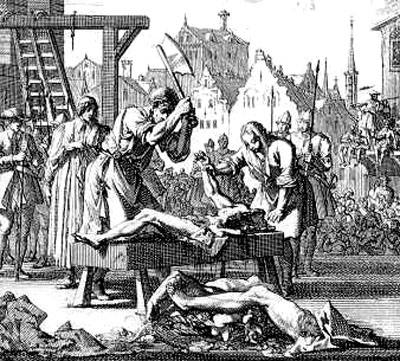
Within days of Cromwell's demise in 1540, six others were put to death. Three of them were Reformists burnt at Smithfield. The other three were Catholics who were hanged, drawn, and quartered after convictions of treason. Henry's inquisition sniffed out any who preached against Catholic tenets of faith or failed to recognize him as God's new representative to replace the Pope. While Henry tended to charge Protestants with heresy and Catholics with treason, it came down to the same thing: failure to worship Henry.

He cruelly dealt with his own daughter based upon this tyrannical need to place himself above all others. Not only did he steal the title of princess from the girl who had been raised to believe that she would be his heir, but he kept her from her mother and dismantled her household. Mary was adamant that she would not deny her faith or the legitimacy of her parents' marriage, so Henry punished her further. Refusing to allow Margaret Pole, Mary's godmother and former governess, to support Mary's household, he sent the former princess to wait upon her infant half-sister, Elizabeth. Among rumors that Anne Boleyn would have Mary poisoned or that Charles V might rescue her and take her to Spain, Henry inflicted even greater punishment by refusing to visit her himself and having her closely watched.

Heretics burned at the stake
Nothing besides complete obedience could ensure survival during Henry's reign. The fate of his wives attests to this, and his treatment of other friends and family was not much better. Thomas More, Thomas Wolsey, Margaret Pole, and countless others enjoyed Henry's favor for a time before his wrath was turned upon them each for nothing more than failing to agree with him and make events occur according to his wishes. In the case of the Pole and Courtenay families, thinning their numbers also relieved Henry of the threat of Plantagenet royal bloodlines.

Traitors hanged, drawn, & quartered
Many theories exist to explain why Henry turned into a bloodthirsty egotist as he got older. Would he have broken with Rome if Katherine had successfully borne him a son? Early in his reign, he had welcomed his extended family to court, but he became increasingly threatened by them as their broods grew and his did not. Did injuries cause brain damage that made him suspicious and cruel? His temper increased exponentially with age and onset of diseases. Whatever the reasons, heresy against the Church of Henry was a charge to be carefully avoided in Tudor England.


Monday, April 18, 2016

Historic Places: England's Lake District

Many regions of England appear to come straight from one's imagination or a storybook. No place is this more true than in the Lake District. Low mountains that clouds have settled to rest upon create hiding places for crystal clear lakes, bubbling streams, and winsome thatched roof houses.

Exploring this area, one also sees many of the sheep that have been part of the Lake District economy since the middle ages. Stone fences leave meandering lines across the hillsides in a casual attempt to keep the community herds separated. When they do mingle, splashes of different dye colors across the animals' backsides identify each sheep's owner.

Lake Windermere is a defining feature of the Lake District. A long, narrow lake that has naturally occurred within a glacial gash, Windermere is a National Park and England's largest lake. The town of Windermere is just one of several that dot the countryside, suddenly appearing as you overtake an incline or peek around a hill.

One person who made a great effort to preserve the idyllic nature of the Lake District was author Beatrix Potter. Her 17th century house is kept much as it was when she was alive, and we were blessed enough to enjoy fresh scones and tea there. Those dried up things that we Americans call scones have no resemblance to their tasty English cousins! During her lifetime, Potter spent much of her earnings to purchase Lake District properties and save the region from commercial development. Her efforts have reached into modern day, with subsidies in place to enable sheep farmers to carry on as they have for hundreds of years.

If the very home of a storybook writer is not a fantastic setting enough, you can make your way to Grasmere. In this little village full of quaint stone buildings, it is easy to believe that you have stepped into another place and time. This tiny community has a lot to offer, including St. Oswald's Church where one can visit the grave of William Wordsworth.
By this time, you will already have no wonders about how he was so inspired to write within these surroundings. The church stands on a site that has been home to a Christian congregation since the medieval King Oswald's reign in the 7th century. Portions of the current church date back to the 14th century with numerous additions and improvements made in the intervening years.

Not far from Grasmere, Ambleside is another picturesque village made up of ancient cottages. One with a past as interesting as its architecture is the Bridge House. This unique building was originally constructed above water rather than land as an early form of tax evasion. The minuscule two room house has been home to an apple store, a family with six children, and a recruitment center during its varied history.

For an area that is famous for its pleasing rural beauty, the Lake District has many interesting stops and historic places to offer to adventurous explorers.

Tuesday, February 16, 2016

Historic Places: Liverpool

Compared to some cities in Britain, Liverpool may be relatively young. It is not listed in King William's Domesday book as a surprising number of modern cities are. The Liverpool and surrounding area is simply referred to as West Derby Hundred, a hundred being made up of 100 'hides' or the amount of land necessary to support a family. The Conqueror sent Roger de Poitou to provide Norman control over Liverpool and Manchester. His motte and bailey castle was sure evidence that the Normans had arrived in Derby.

The city of Liverpool was officially founded somewhat later in 1207, drawing people from the surrounding countryside into the bustling market town. Little evidence is seen of this early settlement today. The wooden castle has long since disappeared, abandoned when King John issued the city charter. Liverpool is left with many street names that point to its medieval past, such as the Castle Street that used to lead to its namesake.

During the Georgian era, the muddy pool that gave the city its name was filled in to make room for greater industry. Anyone who lived there before the 18th century would certainly not recognize it today with gargantuan brick warehouses lining the Mersey and sprawling homes and businesses that caused the city population to grow to 15 times its size from 1700 to 1800. Shipping in the famous Triangle Trade filled Liverpool with a new class of wealthy merchants who built impressive Georgian mansions, many of which can still be seen today. Sugar brought in from the West Indies during this time led to a Liverpool doctor being the first to diagnose a well known modern disease: diabetes.

Adolf Hitler spent time in Liverpool before World War I, visiting his brother's family who lived there. He stayed long enough to be rejected by several of Liverpool's art schools and be advised by his sister-in-law to trim his mustache into the one we would recognize. Around 1913, Adolf's brother left his wife in Liverpool to join his brother in Germany. His wife took their son and immigrated to America, where he would later join the army in the fight against his uncle. Isn't history fun?

Anyway, back to Liverpool.

The Liverpool of today is an eclectic mix of old and new. Since more people tend to be interested in more recent pop culture than my own favored eras, you cannot enter Liverpool without hearing stories about the Beatles. We visited The Cavern, where the Beatles put on performances before their crowds grew far too large for the venue. A trip to Strawberry Field and Penny Lane were also on our touristy must do list. We even passed the shelter in the middle of the roundabout. (I couldn't help but wonder what all the local school children thought of buses filled with people stopping every day to take pictures with a street sign.)

Before visiting, I did not realize that Liverpool is the home of the largest cathedral in Britain. It is a quite different structure than the medieval churches that come to mind when one thinks of cathedrals, though it is built in a throwback style. It is difficult to comprehend the scale of this enormous church, until you notice the people standing outside that appear ant-sized compared to the soaring cathedral walls. It was built between 1901-1978 in various phases as the congregation could afford construction. The result is breathtaking. We happened to be going by in the evening.

With only one afternoon to spend in Liverpool, we did a whirlwind tour and prepared to head for the Lake District.


Thursday, January 28, 2016

Historic Places: Stratford-upon-Avon

Shakespeare's Birthplace
We are still making our way up the western side of England as we explore a sampling of the historic places that Britain has to offer. Before you know it, we will be in Scotland, but first we will enjoy a stop in Stratford-upon-Avon, the birthplace of William Shakespeare.

Shakespeare's Birthplace (rear)
This is a lovely little Tudor style town with several of the distinctive timber beam structures, and even more painted to look like that's what they are. Two of the finest examples are homes directly related to Stratford's most famous resident. The home that Shakespeare lived in as a child sits on the main pedestrianized street next to a museum dedicated to him. Even before his own success, it is clear that his family was affluent based on the home that is an impressive size for the 16th century.


Anne Hathaway's childhood home is also restored and open as a museum, displaying more Tudor charm with its English garden and thatched roof. The home remained in her family after she married her famous playwright and visitors can enjoy a visit and step back in time.

Anne Hathaway's Cottage
Even those who are not fans of Shakespeare can enjoy a stroll through the welcoming streets of Stratford. Personally, I enjoyed the fact that we had our first affordable meal since arriving in England during this stop. This is where I decided that I would test ciders while traveling since I kept being offered chardonnay when I requested sweet wine. I had the first of many delicious, fruity ciders here in Stratford. We also got to explore a used book store and would have loved to investigate more shops but it was time to hurry back to the bus.
Henley Street

I digress, back to the history of Stratford. The whimsical sounding name Stratford-upon-Avon comes from the fact that a Roman road ran along a river where this settlement popped up. 'Straet ford' is the ford by the Roman road, and 'avon' simply means river. In fact, Avon is the name of several rivers in Britain. Thank the Saxons and Celts for their lovely language that makes up for a lack of imagination in naming things.

Stratford Shops
A market town that managed to thrive through the plague years, Stratford was bustling by Tudor times when the son of a successful glove maker and the daughter of wealthy farmer got together and made history. Modern Stratford continues to enjoy success due to the tourism industry made possible by this beloved couple. Whether you visit their former homes, take in a show at the Royal Shakespeare Theatre overlooking the river, or simply enjoy an afternoon in Stratford's shops, Stratford is a town you will enjoy visiting.

Tuesday, January 19, 2016

Historic Places: Cotswolds

The Cotswold region of England is defined by its low rolling hills, quaint homes built from Cotswold stone, and meadows of sheep outlined by stone walls. This picturesque area is what comes to mind when people imagine their idea of the English countryside. Much of it looks the same as it has for hundreds of years, largely unruined by industry and modernization. A tour through the Cotswolds is ideal for relaxation and taking in scenery.

The city of Bath is in the southern part of the Cotswolds, and it is the gem of the region with its abbey, Roman baths, and beautiful Georgian Bath stone architecture. Stretching up toward Stratford-upon-Avon, which will be covered in its own post, villages like Stow-on-the-Wold are sprinkled throughout the area, giving visitors charming opportunities to enjoy local culture and history.

Throughout medieval times and up until industrialization reinvented the economy, the Cotswold region was exceptionally affluent due to the wool trade. One can still see plenty of sheep grazing on the green grass of the Cotswolds, but it has been centuries since wool made anyone rich. In fact, subsidies are in place to keep sheep farming a viable living for those who enjoy it. The prosperous wool merchant is a artefact of the past.


As a designated Area of Outstanding Natural Beauty, the Cotswolds are preserved and protected from new building that would undermine the character of the region. The majority of buildings are created from Cotswold stone, a deeper golden version of Bath stone, so that even the homes and businesses look as though they naturally appeared there. A village that is a wonderful example of this is Stow-on-the-Wold.


Perched on a hill overlooking the surrounding countryside, Stow is an ancient market village that still boasts its medieval era stocks as you enter town. The elegent stone buildings and gardens will give you the feeling that you have stepped back in time, as will some of the passageways that were not built with modern heights in mind! Stow is also the location of a English Civil War battle in 1646, having played host to King Charles I on several occassions throughout the years of the wars.

Saturday, January 9, 2016

Historic Places: City of Bath

You've probably seen images of Bath in movies or British television programs. It has been featured in a vast array of films from Les Miserables to Persuasion to the new Poldark series. This fairytale-like city is the ideal backdrop for historic stories due to its picturesque setting and homogeneous design. Having an idea of what to expect in no way prepares you for that first view from the road up above when the breathtaking city of Bath suddenly appears in the valley below.

Bath has been settled since at least the first century AD, as evinced by excavations of the Roman ruins that include the famous baths that give the city its name. Though the site is centuries old, new discoveries continue to be made as researchers - and sometimes construction workers - reveal new finds on a regular basis. When you visit the Roman Baths, you may be surprised by the sprawling size and how close it places you to ancient history. Visitors are invited to enter many of the rooms that were once frequented by Romans, and a handy audio tour enables you to complete the picture by filling in the gaps left in the ruins and describing the function of each room. A glass floor allows you to see the innovative heating system that was used to keep rooms so warm that sandals had to be worn in order to avoid burning bare feet. You will not find another example of preserved history quite like this anywhere in northern Europe.


UNESCO has named Bath a World Heritage site of Outstanding Universal Value largely due to the presence of the Roman Baths and Temple of Sulis Minerva, but Bath has much more to offer. Bath Abbey built by Henry VII stands just a few steps from the Roman Baths and is a stunning example of Gothic Architecture that blends in seamlessly with the Georgian style that makes up the remainder of the city. Though the Abbey had not been completed by the time the first Tudor king's son enacted the Dissolution of the Monasteries, Bath Abbey, unlike so many other religious houses, survived the wrath of Henry VIII. One of the most eye-catching features of the front of this church is the ladder that begins at the top of the church door and displays angels traversing to and from heaven. The interior of the Abbey is no less riveting with extraordinary stained glass that is a more recent addition since the original glass did not escape Henry VIII's notice. Started in 1499, Bath Abbey may be the latest example of medieval cathedral architecture, and it continues as a center of worship to this day.

Both of these popular tourist stops are ones that you should not miss, but the magic of Bath is the city itself. Designed by father and son architects, John Wood Senior and Junior, along with Ralph Allen and Richard Nash, Bath is the result of a dream to create the most beautiful city in the world. Many agree that they achieved this goal. The city was completely rebuilt in the 18th century to create an inviting and aesthetically pleasing community. The buildings are built from locally quarried Bath Stone that has a light golden color similar to sandstone. The facades of terrace houses were designed to give a uniform appearance of a single structure, while residents were free to design their homes as they chose behind the facade. The result is a hodgepodge of sizes and evidence of originality if you get a rear view of one of the row houses.

Some of the best known and most visually stunning examples of Bath architecture include the Circus, Pulteney Bridge, and the Royal Crescent.

The Circus was designed by John Wood in the fashion of the Roman Colosseum, circular in form and growing more ornate as one moves up the height of the buildings. Wood used the dimensions of Stonehenge as the basis of his design, creating a 318' diameter for the elegant curved structures. Unfortunately Wood did not survive to see more than the beginning of construction, which was then finished by his son.

John Wood the Younger also went on to design the Royal Crescent, another curved facade that looks out onto Victoria Park. Very similar in style to the Circus buildings, the Royal Crescent stretches 30 townhouses wide and includes some of the highest priced real estate in the city.

Completed in 1774, Pulteney Bridge was designed to imitate Venetian style architecture with shops lining the entire span of the bridge. While the bridge has undergone renovations and rebuilding in the years since, it remains one of only four bridges of its type in the world.


Bath has long been a desirable home for those who love the architecture nestled within natural beauty as well as a private getaway for the rich and famous. Strolling down the streets that seem to have emerged straight from a storybook, you will quickly understand why.

Tuesday, December 29, 2015

Historic Places: Stonehenge

We are going to head out of London for now and return there at the end of our virtual tour. As I did while I was in England, we will travel west toward the storybook city of Bath. That is a stop worth looking forward to! For today, we visit the ancient and mysterious monument known as Stonehenge.

Stonehenge is located in Wiltshire, but all you will see from this English Heritage site is fields and sheep. If you're planning your day right, you will coordinate this stop with a trip into nearby Salisbury to see the breathtaking cathedral. Unfortunately, we were on a guided tour that did not include the Salisbury side-trip, so I will stick to Stonehenge for this post. (If you have visited Salisbury, I would love to hear about it and see pictures in the comments below.)

Visitors to Stonehenge vary from those who are intensely excited about the possibilities that exist in the location's mysterious past to those who wonder why so many people get excited about a circle of large stones. If you love the opportunity to investigate history and determine what really happened centuries ago, you will appreciate the model village, museum, and walking tour of Stonehenge.

Arriving at Stonehenge actually places you at the visitors' center with an additional mile to walk or ride the bus to the monument itself. At the visitors' center, you may stroll through the museum displays, grab a snack at the cafe, or try your strength at pulling a stone into place in the model Neolithic village. The museum is rather small and contains artifacts that fit nicely into the various theories that you will hear about on the audio tour. My favorite part of this building was the 'Wish You Were Here' exhibit. This is a circle shaped room with images projected on the walls to place visitors at the center of the Stone Circle throughout the ages. Witness Stonehenge being built, used, and weathered by time in the course of a few moments.

When you make your way out to the Stone Circle, an audio tour points out a variety of facts, theories, and views that you'll want to take advantage of. Stonehenge was built approximately 5000 years ago using simple tools to bring stones weighing up to 30 tons into place from distances believed to reach into Wales. Why go through this much work? Well, that's where it becomes a bit of a treasure hunt.

My husband theorized during our visit that the entire area was simply half built at the commands of a petulant prince who got bored before it was complete. The audio tour and museum offer more sophisticated explanations.  ;-)

There was originally more to the Stone Circle than we currently see, as several displays will show you. It is known that the area was used as a cemetery for centuries, but the extent of religious ceremonies that may have taken place is less certain.
The stones have been shaped to be more finished and aesthetically pleasing from the north-east, giving the circle a definite 'front' and 'back.' While some stones are carefully smoothed and shaped, others are left unfinished for unknown reasons.

Uses for the Stone Circle likely evolved over time, possibly being used as a seasonal clock, gathering place, and religious center. There is no question that the enormous stones were carefully placed to align with the movement of the sun through annual solar events. But why? Was it used to predict and track seasons or was this simply a pleasing design for a king's coronation? These are questions that the enthusiasts of Stonehenge continue to discuss and investigate.


A surprising amount of the Stonehenge area has not been excavated by archaeologists, so possibilities of new discoveries are very real. Ongoing research will continue to answer the questions that people have been asking for hundreds of years about Stonehenge, but with each new discovery more questions arise. Will we ever know the complete history of Stonehenge? Probably not, but that's the fun of it, isn't it?


 For more information on Stonehenge, visit the UK's English Heritage website.

Monday, December 14, 2015

Historic Places: Tower of London

My readers are probably not surprised to hear that the Tower was my most anticipated stop while we were in London. So much history has been witnessed by these stone walls that I wish I could hear them whisper their story. The Tower is a significant setting in my most recent novel as the place where Elizabeth's brothers disappear and she dies after delivering her last child.

If you have not visited the Tower or other castles, you may not realize that the setting is much more like an enclosed village than a single tower. Our romanticized vision of a castle more closely resembles a standard castle keep than the entire complex.

As you can see from the first picture, some of the stone shows its age more than others. The famous White Tower, built by William the Conqueror from stone that he had transported from Normandy looks amazing for being almost a millennium old. The White Tower is the central stone keep of the fortress, built by the first of England's Norman kings to establish his dominance in the capital of his new kingdom. The rest of the castle grounds would grow up around this impressive, white-washed stronghold. Through the centuries since William's 1066 invasion, this tower has served primarily as a stronghold but also as a prison and storage facility.

The White Tower was an archaeological wonder of its day at a height of 90' with walls that are 25' thick at their base.

Plantagenet kings of medieval times continued to increase the sprawling fortress' size and uses. The 12th-14th centuries saw the Tower of London become much of the structure that is seen today surrounding the White Tower. During the reign of Edward I, the Tower was recognized as an ideally secure place to store jewels, records, and the royal mint.

During the 15th century Wars of the Roses, possession of the Tower was a strong indication of possession of the kingdom. A strange combination of a palace and a prison, the Tower was where monarchs spent the night before their coronation, but it was also where they housed their worst enemies - just not in the same tower.


Though the castle is known as the Tower of London, it is truly made up of several towers, which may lead to some confusion. We have already discussed the original White Tower which stands at the center of the castles concentric design. Smaller towers surround it, including the Beauchamp Tower, famous for housing Tudor era criminals. The Bloody Tower is a relatively small tower where the sons of Edward IV were staying when they famously disappeared...were murdered? That's a discussion for another day.

Inside any of these towers, you can feel the atmosphere of history prickling at your senses. I could not resist running my fingers along the stone walls within the narrow staircases, hoping that I just might find a spot that Elizabeth's hand touched over 500 years ago. Admittedly, the feeling is somewhat reduced by the rather modern radiators that give the structure warmth while the large fireplaces lie dormant, but I did not mind as much that there were wooden stairs outside to save me from climbing a ladder.

Strolling through the Tower Green, the architecture and beauty of the place can almost make one forget that the grass has been fed with much blood. It is a beautiful setting filled with smiling tourists and friendly Yeoman Warders.
Within the ring made up by these and several other towers, visitors could easily walk by the Execution Site without realizing what it is. Memorializing multiple political prisoners of the crown, the spot is now home to a frosted glass and granite monument in place of the bloody scaffold. At this site, three of England's queens were beheaded. Each has their name etched into the edge of the glass: Anne Boleyn, Catherine Howard, and Jane Grey. Others who had their last view of the Tower from this spot include Margaret Pole, William Lord Hastings, Jane Boleyn, and Robert Devereux. Each of these deaths demonstrate just how quickly fortune's wheel could turn in the 15th and 16th centuries.


Thankfully, Henry VIII did more than execute people at the Tower, though he did plenty of that. To walk through the Tower gift shop, one would think that he was the only king England had ever had, but I digress.

Henry enjoyed building projects almost as much as the hunt for a new wife. His contribution to the Tower grounds, besides noble blood, includes the timber structure - very recognizable as Tudor era - that was designed as a royal residence for Anne Boleyn.

One of the most popular exhibits at the Tower is the Crown Jewels. This includes an education on the English Civil War of the 17th century, a time when the crown jewels were melted down and torn apart. Sometimes for their value, sometimes out of spite. There is a vast amount of elaborate jewelry and accessories to be viewed, but they cannot be photographed.

The 19th century saw the Tower's evolution from a practical fortress to a historical monument. With the moat drained and the mint removed to another location, the Tower began to enjoy a peaceful retirement. It was not completely out of commission until after Britain's involvement in the World Wars. The last executions to take place on Tower ground were those of World War I & II spies.

One element remains constant as the Tower has become a tourist destination rather than a place to inspire the kind of fear that made Anne Boleyn collapse and cry out as she was escorted through Traitor's Gate. It is the ravens. According to legend, "If the ravens leave the Tower, the kingdom will fall." In the interest of the empire, the Tower is home to ravens with clipped wings and luxurious lodgings. The Yeomen Warders have little else to guard these days than their black feathered friends.

During our visit, the White Tower was home to a special 600th anniversary exhibit for the Battle of Agincourt. A large battle map was set up in the center of one room. As we approached it, my husband said, "So, tell me what is going on here." Ah, to have someone request to be regaled with medieval knowledge! It was great fun, and we enjoyed each of the informative displays that are located throughout the various buildings and towers.

Have you visited the Tower of London? There is so much to see within this single stop! What did you enjoy the most?