Showing posts with label Stuart Rudge. Show all posts

Monday, September 13, 2021

El Cid: Discerning Fact from Fiction

It's a pleasure to welcome Stuart Rudge to the blog again today with some insight into discerning fact from fiction when writing historical fiction in his Legend of the Cid series. How much of that story is true? It just might surprise you!

Welcome, Stuart!

Samantha

~~~~~~~~~~~~~~~~~~~~~~~~~

Ed Cid: Discerning Fact From Fiction

Guest Post by Stuart Rudge

The previous three novels of the Legend of the Cid series dealt with the early life of Rodrigo Diaz de Vivar, El Cid Campeador, from his humble beginnings as a knight from Castile, through his tenure as alferez to Sancho of Castile and his role in the struggles between the sons of Fernando. Master of Battle advances the story with some of the most significant events in his life; his marriage to Jimena Diaz, his acquisition of the legendary sword Tizona, and how he came to receive the title of El Cid.

Rodrigo and Jimena

By 1073, after the long period of unrest in Leon and Castile caused by Fernando’s death nearly a decade earlier, Rodrigo would have been around thirty years of age. For a man of his importance and age to be unmarried was rather uncommon. We do not know the circumstances of their first meeting or betrothal, but we know Rodrigo and Jimena wed in the city of Palencia on July 1074. It is generally accepted that Jimena was an Asturian, the daughter of the Count of Oviedo, and a distant cousin of Alfonso through their grandparents. Royal blood and a Visigothic lineage would have made her a worthy bride for any lord looking to advance his status. Perhaps the royal connection was a tool Alfonso used to ensure Rodrigo’s loyalty, having served Sancho so vehemently for years. The original marriage contract survives to this day, and the signatories included the king himself as well as many of the leading lords of the kingdom, showing the marriage was a grand affair and celebrated by many in Leon and Castile. After years of civil strife, it was proof Leon and Castile could coexist together once more.

Rodrigo and Jimena in Amazon’s El Cid
Source: Daily Express


Part of the mythical legend of the Cid has him kill Jimena’s father in a duel, as depicted in the Charlton Heston film, but there is no historical evidence to support this. Indeed, there is debate as to who her father was; Diego Fernandez, the count of Oviedo featured in this series, may not have been a real person, but to me is the most likely candidate. Almost nothing is known of her mother, but her two brothers Fernando and Rodrigo both served as counts of Asturias at some point in their lives.

In regards to Master of Battle, there is nothing to suggest Jimena ever had an affair with another man, for her early years are shrouded in mystery, and the complex love story between Antonio and her is purely fictional. Rodrigo and Jimena would go on to have three children; Christina, Maria and Diego, and with a swath of estates from their marriage, they would not have lacked for wealth. The initial years of marriage seemed to be fruitful and uneventful. But there is always something, or someone, willing to upset the status quo.

Tizona

The name of the sword of the Cid first appears in the Cantar del mio Cid, where it is called Tizon; the poem dates to around 1160-1200 AD, just a few generations after the Cid lived, and thought some historians doubt its existence, it seems highly likely to me that he carried a blade of that name. The name seems to come from the Latin titio, which means 'embers, burning wood', or ‘firebrand, burning torch’. Though a real sword with the same name is currently housed in the Museum of Burgos, it is most certainly not the original. An examination of the blade in 2001 suggested it could have originated in the eleventh century, but the cross guard and pommel are of a Gothic style and date to a few centuries later, and so it is unlikely it the true blade which the Cid carried in to battle.

Tizona in the Museum of Burgos
Source: Wikipedia


The origins of the blade remain a mystery. The Cid had a military career spanning nearly four decades, and fought countless battles, so it is almost impossible to say. It could have been taken from a Moorish captive after some raid or significant battle; it may have been a gift from the amir of Zaragoza or Seville. The Cantar del mio Cid claims he won it from the King Yusuf of Valencia. As a historical fiction writer, I have used a little bit of research and creativity to produce an original origin story for the Cid’s acquisition of Tizona.

The Historia Roderici claims that the Cid did battle and defeated a champion of Medinaceli, but does not provide a date as to when this duel allegedly took place. Medinaceli is a town in eastern Spain, and the name derives from the Arabic Medina Salim, which meant ‘the safe city’ as it was perched on top of a hill, surrounded by a stout wall and protected by a castle. In the year 1080, a raiding party of Moors proceeded north from Medinaceli, or the area around it, and attacked the fortress of Gormaz, at that time under Castilian control, and laid waste to it. In retaliation, El Cid led an attack of his own and devastated the Moorish countryside, taking many slaves back to Castile with him. In popular tradition this act intensified an already strained relationship between Alfonso and the Cid. During the Cid’s act of retribution against the Moors, is this where he faced the champion of Medinaceli? It seems entirely plausible, and so in Master of Battle, it was all too tempting to include the duel and have the Cid take the sword of his adversary as his own.

The Battle of Cabra

The first third of the book heavily involves Garcia Ordóñez. During the reign of Sancho he had been lord of Pancorbo in eastern Castile, and seemed to have held a position of prominence; he was the signatory of several of the king’s charters, and his father had once been alferez to Fernando of Leon-Castile. In 1074, we know that he held the same position as alferez to Alfonso, and he was even a witness and signatory of Rodrigo and Jimena’s marriage contract. Then he vanishes. He is not seen in court again until the year 1080, when he

is named as count of Najera in the Rioja. Where had he been for the previous six years? We cannot be certain, but it may be he was stripped of his power and exiled from the kingdom for some undisclosed slight against the king, and it is this little snippet of possibility which I use for the inspiration for the trial of Antonio and Jimena and his subsequent exile.

Whatever Garcia’s political status in 1079, in some versions of the Cidian legend, it is recorded that he led troops belonging to the amir of Granada and attacked the taifa of Seville. Whether or not this venture was authorised by Alfonso is unclear, but it just so happened Rodrigo, one of Garcia’s most prominent political rivals, was in Seville at the time, collecting the parias tribute. Details are sparse but, believing he was defending the king’s interests in al-Andalus, Rodrigo did battle with Garcia, defeated and captured him at Cabra, and held him captive for three days. But the king was enraged with such an act, and whilst Rodrigo was reprimanded by Alfonso and his standing plummeted, Garcia’s stock rose with him becoming a count and gaining a bride of high standing in Urraca, the sister of the late King Sancho of Navarre.
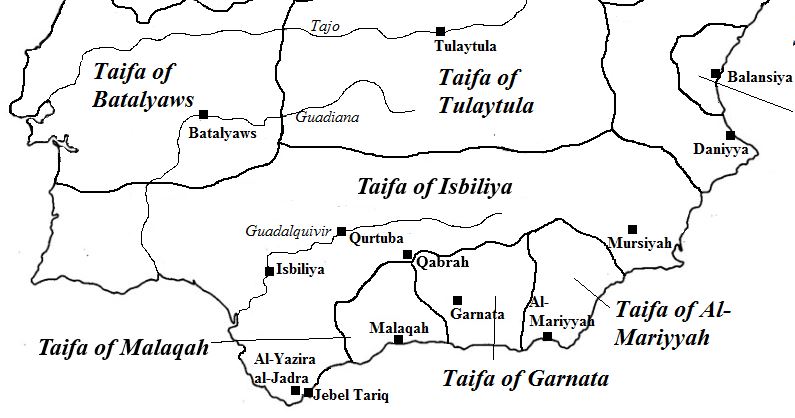
A Map of Al-Andalus, 1079 AD
Source: Stuart Rudge


The term Cid derives from the Arabic honorific title al-Sayyidi, and translates as “The Master”. There is no definitive date for when Rodrigo gained this title, and neither do we know the identity of the man who bestowed it. In Amazon’s El Cid series, he is given it by the Moors after the battle of Graus in 1063. If Rodrigo did perform heroics in the battle, it is entirely plausible to have been named the Cid, but personally I believe he would have been too young to receive it after Graus. I have decided to bestow it upon him after Cabra, where a host of Muslim warriors and the amir of Seville himself would have witnessed Rodrigo’s heroics and prowess. Placing it at this point also gives the likes of Pedro Ansúrez, the king’s closest advisor, and Garcia Ordóñez an extra reason to petition the king for punishment against him; after all, if a Christian warrior is given an honorific title by the Moors, it can only increase the animosity with his jealous comrades.

I must now confess that, as a historical fiction writer, I have bent the truth of history slightly to satisfy my narrative. In this novel, the Battle of Cabra takes place after Rodrigo’s raid in to the taifa of Tulaytula; in reality, it was the other way round, for Cabra took place in 1079, and the raid in 1080. In the real series of events, the fact that Rodrigo would fight for a Muslim amir against his own comrades from Castile was a point vehemently taken up with the king by his enemies, and he most likely received a reprimand for it. Then in the following year, when raiders from Toledo attacked the great fortress of Gormaz, Rodrigo led his own incursion in retaliation – without the authority of the king. After defeating the Moorish force, Rodrigo laid waste to the surrounding area, allegedly taking thousands of slaves and returning to Castile as a rich man. But for all the wealth he plundered, his actions had serious ramifications…

Master of Battle by Stuart Rudge

Peace reigns in the Kingdom of Leon-Castile, and Antonio Perez returns to his native Asturias to discover the fate of his remaining family. Whilst there, he reconnects with Jimena, his childhood companion and the girl he once loved. But when his loyal friend Rodrigo and Jimena fall in love, Antonio is consumed by jealousy. As the wedding of two of his closest companions approaches, Antonio must battle his enemies and his inner demons, lest it lead to the ruin of all he holds dear.

Having secured his borders, Alfonso VI of Leon-Castile pushes south against the Moors. When a raid by the Moors threatens Castile, Rodrigo leads his men on a daring campaign of vengeance. But with the venture a credible threat to the uneasy peace Alfonso has brokered with the taifa kings, Rodrigo’s bravado could have dire consequences to himself and the security of the kingdom. With enemies old and new circling, will Rodrigo Diaz de Vivar find greatness on the battlefields of Hispania, and cement his reputation as one of the most feared warriors in the land, or will his actions lead to his ruin?

Master of Battle is the exhilarating fourth instalment of the Legend of the Cid.

Available now on Amazon UK and Amazon US


Connect with Stuart

Stuart Rudge was born and raised in Middlesbrough, where he still lives. His love of history came from his father and uncle, both avid readers of history, and his love of table top war gaming and strategy video games. He studied Ancient History and Archaeology at Newcastle University, and has spent his fair share of time in muddy trenches, digging up treasure at Bamburgh Castle.

He has worked in the retail sector and volunteered in museums, before working in York Minster, which he considered the perfect office. His love of writing blossomed within the historic walls, and he knew there were stories within which had to be told. Despite a move in to the shipping and logistics sector (a far cry to what he hoped to ever do), his love of writing has only grown stronger.

Rise of a Champion and Blood Feud are the first two instalments of the Legend of the Cid series. He hopes to establish himself as a household name in the mound of Bernard Cornwell, Giles Kristian, Ben Kane and Matthew Harffy, amongst a host of his favourite writers.

Connect with Stuart through his blog, Facebook or Twitter.

Saturday, February 6, 2021

The Fall of Kings

 I am happy to welcome a new guest to my blog today. Author Stuart Rudge's Legend of the Cid series transports readers into 11th century Spain, a world of knights, battles, and precarious crowns. To celebrate the publication of his third book, The Fall of Kings, Stuart is here to discuss the history behind his story.

Welcome, Stuart! 

~ Samantha

~~~~~~~~~~~~~~~~~~~~~~~~~

The History behind The Fall of Kings

Guest Post by Stuart Rudge

The years 1071-1072 proved to be a pivotal period in the story of Rodrigo Diaz de Vivar, the man known as El Cid, and also of medieval Spanish history. For in this year, all three sons of Fernando the Great were either deposed from their thrones and sent in to exile, or killed, and four of the five siblings had been involved in a dynastic feud. By the end of the year, only one man remained to take all three thrones, and ruled over a kingdom as vast as his father had done.

Upon Fernando’s death in 1065, his kingdom had been divided between his sons; Sancho became King of Castile, Alfonso received Leon, and Garcia inherited Galicia. His daughters Urraca and Elvira gained control of the Leonese cities of Zamora and Toro, respectively. Relations between the brothers had been tense ever since the death of their mother Sancha in 1067. Yet despite the tension, the only moments of note came from Alfonso wresting control of the parias tribute of Badajoz from Garcia in 1068, and a few months later at the battle of Lantadilla; although it was touted as a Castilian victory over Leon, it is only recorded as a minor skirmish between the two kingdoms.

The division of Fernando’s kingdom: Copyright Stuart Rudge


Tensions eventually came to a head in the year 1071, with the conquest of Galicia. There seems to be confusion over the events of the conquest itself, or simply they do not add up. One source claims that Alfonso and Sancho met in private some months prior, and conspired to conquer Galicia and divide the realm equally; a surviving document names Alfonso as King of Leon and Galicia, and Sancho as King of Castile and Galicia, at the same time.

Another source suggests Sancho rode across the kingdom of Leon, using the excuse of a pilgrimage to Santiago de Compostela, then fell upon Garcia and forced him to submit. And a final source claims Sancho sent Rodrigo to pluck Garcia from his crumbling kingdom and escort him to Burgos as a prisoner. In any instance, it would prove difficult for Sancho to rule Galicia, given that Alfonso’s domain lay directly between the two. It is likely that it was Alfonso who claimed Galicia, as charters from the king of Leon from the time have Galician bishops as signatories, and Garcia was eventually sent in to exile in Seville. This left Alfonso and Sancho to fight for the ultimate prize.

The decisive clash came at Golpejera, some thirty kilometres west of the Pisuerga River, which was the natural barrier between Leon and Castile. The date of the battle is accepted as being between 2nd and 5th January, 1072, at a time where winter would have settled in the plains of northern Spain and made for hellish conditions for a battle. This suggests Sancho wanted to catch Alfonso without the bulk of his forces from Asturias and Galicia, as these would have taken some weeks to assemble. Legend places Rodrigo at the heart of the battle as Sancho’s alferez, or standard bearer, and though it is believed Alfonso carried the day, the forces of Castile rallied during the night and struck back; Rodrigo is said to have personally captured Alfonso and delivered him in chains to his brother. How much of this is true and simply included for epic narrative is debated. Regardless, Sancho bested Alfonso and was crowned king of Leon, Castile and Galicia on 12th January, and Alfonso was sent to the dungeons of Burgos.

Yet Sancho’s reign was doomed from the start. The Leonese did not support his tenure as king; indeed Bishop Pelayo of Leon, the most senior member of the clergy, refused to place the crown upon Sancho’s head. The sheer size of the realm proved another sticking point. For example, to travel from Leon to Portugal, then Galicia and Asturias, and finally to Burgos and back to Leon would take several months on the road for a mobile court, and for a new monarch like Sancho to gain the support of all of his subjects, it would take a considerable deal of time and effort. And to garner more support, it was necessary for Sancho to appease his sisters, Urraca and Elvira. The infantas were ever present in confirming Alfonso’s charters, but had much less of a role in Sancho’s court. The new king seemed to strike a bargain for their backing by sending Alfonso in to exile to Toledo instead of keeping him imprisoned. But ultimately, Sancho’s short tenure as king would soon come to a bloody end.

Urraca, along with Pedro Ansúrez of the Beni Gomez clan, who was a close friend and advisor to Alfonso, openly rebelled against Sancho’s rule and chose Urraca’s domain of Zamora as their bastion. Sancho was killed before the walls of the fortress on the Duero in early October, although there is debate about the nature of the conflict that took place. The

Najerense Chronicle would tell us that Sancho besieged the rebels, and that a man named Velliti Ariulfi, posing as a deserter and offering to show Sancho the weak spot in the defences, murdered him. Rodrigo allegedly chased him back to the city and, in a grief stricken rage, faced off against fifteen enemy knights, killed several and put the rest to flight.

The Death of Sancho II before the walls of Zamora
Image source: https://www.findagrave.com/memorial/148751052/sancho_ii_king-of_castile

The final events of the year are some of the most iconic in the story of the Cid. Upon hearing of Sancho’s demise, Alfonso returned from exile in Toledo and, after securing the crowns of Leon and Galicia, proceeded to Burgos to confirm the Castilian surrender. The epic scene in the Charlton Heston movie of El Cid, where Rodrigo forces Alfonso’s hands on to a bible to swear the king had no part in Sancho’s death, is purely fictional, or at least exaggerated. It is intended to fall in line with the legend that Rodrigo forced Alfonso to swear before the nobility of Castile that he was innocent of conspiracy and murder before they would accept him as their king, but there is no historical record of it. If this actually happened, we would expect Rodrigo to be punished, or at least be made an example of. Instead, we see his name as a signatory on some of the first charters Alfonso issues upon his confirmation as the one true king of Leon-Castile, showing Alfonso openly admitted him it to his court, albeit in a reduced capacity. From a historical point of view, it is not hard to imagine there would have been some sort of resistance to Alfonso’s coming in a muted capacity; most likely some nobles like Rodrigo would have wanted assurances about the new king’s intentions, but would not have gone so far as to slam royal hands upon a bible, in the hopes of securing some sort of position in the new regime.

El Cid makes Alfonso swear his innocence in the church of San Gadea
Image source: https://laene.blog/2018/01/27/oath-of-santa-gadea/

We may never truly know the circumstances of how Alfonso won the crown, but it left him as the sole ruler of a large kingdom, with members of all three districts in his court. Yet Rodrigo’s time in Alfonso would bring mixed fortunes. Whilst Alfonso recognised the champion of Castile’s service to his brother, Rodrigo did not enjoy the level of prestige he experienced in Sancho’s court. Furthermore, conspiracy and jealously would plague his service in the years to come.


The Fall of Kings is available now on Amazon UK and Amazon US.


Castile. 1071AD

Three kings. One crown.

After Sancho II of Castile dispatches his champion Rodrigo Diaz de Vivar to capture his brother, King Garcia of Galicia, he hopes it is a defining moment in his quest to reunite the lands of his father under one banner. But Alfonso VI of Leon is one step ahead, and has already added the lands of Galicia to his domain. When the only alternative is war, Sancho turns to Rodrigo to lead the armies of Castile, and he must use all of his tactical acumen to defeat the Leonese in the field. Only one son of Fernando can claim victory and become the Emperor of Hispania.

Rodrigo and Antonio, now a knight of the realm, find difficulty adjusting to the new regime. Dissent and unrest run rife throughout the kingdom, and the fear of a knife in the dark from enemies old and new hangs heavy upon the pair. But if it is allowed to fester, it threatens to undo all that has been achieved. Can Rodrigo and Antonio root out the enemies of the king, and prevent chaos reigning throughout the land?

The Fall of Kings in the breath taking third instalment of the Legend of the Cid.


The Fall of Kings is available now on Amazon UK and Amazon US.


Connect with Stuart


Stuart Rudge was born and raised in Middlesbrough, where he still lives. His love of history came from his father and uncle, both avid readers of history, and his love of table top war gaming and strategy video games. He studied Ancient History and Archaeology at Newcastle University, and has spent his fair share of time in muddy trenches, digging up treasure at Bamburgh Castle.

He has worked in the retail sector and volunteered in museums, before working in York Minster, which he considered the perfect office. His love of writing blossomed within the historic walls, and he knew there were stories within which had to be told. Despite a move in to the shipping and logistics sector (a far cry to what he hoped to ever do), his love of writing has only grown stronger.

Rise of a Champion and Blood Feud are the first two instalments of the Legend of the Cid series. He hopes to establish himself as a household name in the mound of

Bernard Cornwell, Giles Kristian, Ben Kane and Matthew Harffy, amongst a host of his favourite writers.

Connect with Stuart through his blogFacebook, or Twitter.