Showing posts with label Toni Mount. Show all posts

Saturday, February 18, 2023

Historic Places: St Helen's Church


Hello, dear readers! You will recognize my guest today, because she has been here before. One of my favorite book series is by the fabulous Toni Mount, and she is here to talk about the newest installment, The Colour of Bone. If you haven't fallen in love with Seb Foxely yet, it's time for you to start this series!

Welcome, Toni!

~ Samantha

~~~~~~~~~~~~~~~~~~~~~~~~~

St Helen's Church, Bishopsgate: Life and Death in Tudor London

Guest Post by Toni Mount

This blog evolved following a research trip to St Helen’s Church in Bishopsgate, checking out details and searching for inspiration for my next Sebastian Foxley Medieval Murder Mystery, The Colour of Bone. St Helen’s and its near neighbour, St Andrew’s Undershaft – ‘undershaft’ refers to the maypole kept at this church in medieval and Tudor times ready for the annual May Day celebrations – having survived the Great Fire of London in 1666 and the Blitz of World War II, were both badly damaged by terrorist bombings twice in the 1990s but remain as the two medieval churches in the city still in use today.

St Helen’s in particular has a wealth of history and is said to be second only to Westminster Abbey in the number of funerary monuments it contains. It is these monuments which have some intriguing stories to tell concerning those who lived – and died – in Bishopsgate in the fifteenth and sixteenth centuries. 

View of St Helen's Church with its gigantic neighbours,
taken from the 'churchyard' [GRM 2022]


Today, St Helen’s is overshadowed by the modern tower-blocks of the Gherkin and the Cheese-grater and isn’t far from the Shard but, even five centuries ago, its nearest neighbour was reckoned the most imposing secular building in London: Crosby Place. St Helen’s churchyard is now paved over and a solitary tomb stands there, that of a jeweller, Robert Dingley, dated to 1741.

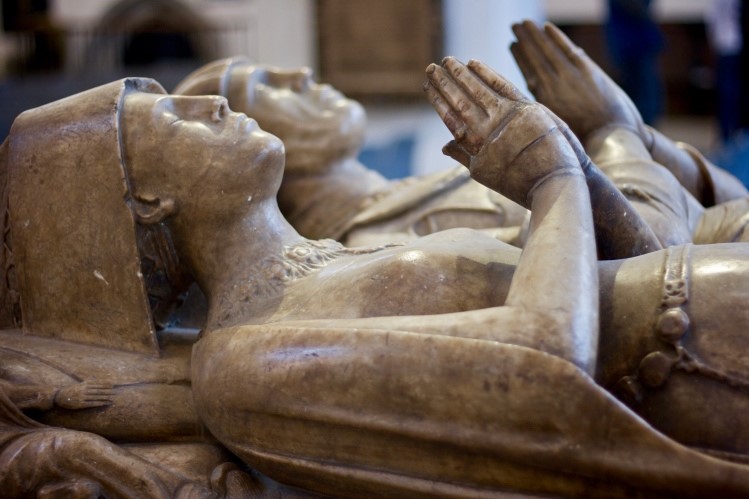
Inside St Helen’s, there is a superb monument tomb of Sir John Crosby and his first wife, Agnes. He is in armour with a Yorkist Suns-and-Roses collar and she wears a fashionable late fifteenth-century headdress with her lap-dogs at her feet. Agnes had predeceased Sir John in 1460 and he designed their joint tomb. 

The tomb of Sir John and Agnes Crosby
in St Helen's Church [GRM 2022]


Sir John also bequeathed 500 marks to St Helen’s Church, money which was used to redesign the interior of the nave. The church had a double nave: the original parish nave and, to the north, a second, parallel nave exclusively for the nuns, constructed in the early thirteen century when William Goldsmith founded the Benedictine convent next door. A row of arches and a screen shielded the nuns from the common folk but Sir John’s bequest was used to build taller, more elegant arches and a new screen in 1480. [This rebuild is the first crime scene in The Colour of Bone.]

Sir John's four new arches viewed from the Nun's Choir [GRM 2022]


In 1538, St Helen’s Priory was surrendered to King Henry VIII, along with all other abbeys, priories and religious houses at the Dissolution of the Monasteries. However, because the church was also the parish church, it was left intact.  

A near-neighbour in Bishopsgate was Sir Thomas Gresham. He was Queen Elizabeth I’s financial whizz and built the Royal Exchange – which he’d intended to name The Gresham Exchange but the queen had other ideas. Even so, Sir Thomas’s badge of the Grasshopper was all over the building and is also on his grand tomb in St Helen’s Church. After his death in 1579, in his will, Sir Thomas left money to set up and pay for Gresham College as a London institute of learning which still exists today as the Gresham Institute.

Sir Thomas Gresham's marble tomb in St Helen's Church [GRM 2022]


Other important citizens and Tudors of note buried in St Helen’s include Sir Andrew Judd who was Lord Mayor in 1550-51 and died in 1558. Sir William Pickering was Queen Elizabeth’s Ambassador to Spain who died in 1574. He also has a splendid marble tomb with his effigy and an elaborate canopy, all protected by wrought iron railings.

Sir William Pickering's effigy lies secure behind railings [GRM 2022]


Another man of interest, although he only has a wall-mounted plaque, is Captain Martin Bond. He lived until 1643, so his monument isn’t Tudor, but in 1588, at the time of the Spanish Armada, he was the commander of London’s Trained Bands – a sort of Elizabethan Home Guard – based at Tilbury in Essex. It seems likely that Bond may have heard Queen Elizabeth making her famous speech to the troops there: ‘I have the heart and stomach of a king, etc’.

Despite the Cavalier fashions, Capt Bond in his tent with the army (1643) [GRM 2022]


Another man of note at St Helen’s is Sir Julius Caesar Adelmare – what a name! He was Master of the Rolls to Queen Elizabeth and lived on to become a Privy Counsellor to King James I, dying in 1636. His wall-mounted monument shows a legal document with the seal broken off in which he has promised to ‘pay the debt of nature’ as soon as God pleases. The debt is, of course, ‘death’, so having died, Sir Julius has fulfilled the agreement and the document becomes obsolete, as shown by the broken seal.

Sir Julius Caesar Adelmare's fulfilled agreement with God [GRM 2022]


Despite all these grand tombs and intriguing monuments, the prize for the tomb that tells the most fascinating story must go to Sir John Spencer and his family. Sir John was another wealthy merchant in the textile trade – so wealthy that they called him Rich Spencer, making his money from trade with Spain, Venice and Turkey. In 1591, he came under suspicion of becoming extraordinary rich … by falsifying and monopolising of all manner of commodities

Being wealthy had its dangers and a story is told later of a plot by a Dunkirk pirate to abduct Spencer and hold him to ransom for £50,000. Leaving his ship with six of his men in Barking Creek, the pirate and the other six crew members made for Islington, intending to seize Spencer on his way to his country house at Canonbury. Luckily for him, the merchant was detained in London on business and the plot came to nothing. How the failed plan became known isn’t revealed but it was recorded in Vanity of the Lives and Passions of Men, published in 1651, long after the event, if it actually happened at all. Queen Elizabeth is said to have visited Spencer at his Canonbury estate in 1581.

In 1583-84, Spencer served as one of the two Sheriffs of London and was required to search out papists in the Holborn area. Among those he arrested were Antonio Bassano and his colleagues, the Queen’s Musicians. He had a lot of explaining to do in this case. Spencer served as Lord Mayor of London in 1594-95. Obviously, his falsifying and monopolising didn’t hold back his political career. At the time, he was living at Crosby Place, although it had needed expensive renovation before it was smart enough to be the Lord Mayor’s official residence. John Stow described Crosby Place in 1598, in his Survey of London as ‘of stone and timber, very large and beautiful and the highest in London’, so Spencer succeeded.

Spencer didn’t have an easy term as mayor. Following years of poor harvests, that of 1594 failed badly and England suffered famine. Spencer managed to persuade the City Companies to send any spare grain in their warehouses to Bridge House, on London Bridge, for distribution to the poor and starving. Hearing of this grain store, Admiral Sir John Hawkins tried to requisition Bridge House and its supplies for the use of the queen’s navy and baking ship’s biscuits for the fleet. Spencer refused and managed to keep the grain to feed the poor. The queen must have approved his actions because she knighted him soon after.

His only child by his wife, Alice Bromfield, [who shares his tomb] was a daughter, Elizabeth, and she has another story to tell. In 1598, William, Lord Compton, proposed marriage to Elizabeth but her father refused to allow the match. Compton used his powerful friends at court and had Spencer arrested and thrown into the Fleet Prison, accused of ill-treating his daughter – we don’t know if he did treat her badly or whether it was a trumped-up charge. Compton then resorted to desperate measures to secure his beloved, having her smuggled out of Canonbury House in a large baker’s basket used for carrying loaves. The couple wed immediately but her father withheld Elizabeth’s dowry, unsurprisingly, and refused to forgive her elopement, even when she gave birth to his first grandchild in 1601. Fortunately, reconciliation was brought about by no lesser person than Queen Elizabeth herself. 

Sir John continued to serve in a civic capacity into the reign of James I, serving as President of St Bartholomew’s Hospital from 1603 until his death ‘at an advanced age’ in March 1610. His wife died just three weeks later and both rest in St Helen’s most colourful tomb. His funeral was sumptuous, his fortune estimated to be between £500,000 and £800,000 – a sum so vast that the inheritance was said to have ‘turned the brain’ of his son-in-law, Lord Compton, temporarily. However, despite such wealth, Spencer bequeathed nothing to the city or people of London. 

The Spencer Tomb [GRM 2022]


His and Lady Alice’s tomb shows the fashionable Elizabethan couple in full colour with their repentant daughter, Elizabeth, kneeling at their feet, wearing a French farthingale. Their monument, severely damaged by the bomb-blasts of the 1990s, was fully restored from photographs, including the paintwork. The whole is topped by a skull and an hourglass as a memento mori. That concludes my tour of the church where the dead of long ago rest in peace. 

[This article first appeared in Tudor Life magazine]
 
In my new novel, St Helen’s isn’t the peaceful haven in the midst of a noisy city that it is today because it’s a building site. Neither are the nuns contemplative quiet souls. All is not as it should be… and you can discover what’s going on in Seb Foxley’s latest medieval murder mystery, The Colour of Bone.


It’s May 1480 in the City of London. 

When workmen discover the body of a nun in a newly-opened tomb, Seb Foxley, a talented artist and bookseller is persuaded to assist in solving the mystery of her death when a member of the Duke of Gloucester’s household meets an untimely end. Evil is again abroad the crowded, grimy streets of medieval London and even in the grandest of royal mansions.

Some wicked rogue is setting fires in the city and no house is safe from the hungry flames. Will Seb and his loved ones come to grief when a man returns from the dead and Seb has to appear before the Lord Mayor?

Join our hero as he feasts with royalty yet struggles to save his own business and attempts to unravel this latest series of medieval mysteries. 

Get your copy of The Colour of Bone on Amazon US or UK!
Or start the Seb Foxely series at the beginning with
The Colour of Poison on Amazon US or UK.


Toni Mount is a best-selling author of medieval non-fiction books. She is the creator of the Sebastian Foxley series of medieval murder mysteries and her work focuses on the ordinary lives of fascinating characters from history. She has a first class honours degree from the Open University and a Master degree by research from the University of Kent however her first career was as a scientist which brings an added dimension to her writing. Her detailed knowledge of the medieval period helps her create believable characters and realistic settings based on years of detailed study. 

Connect with Toni at ToniMount.com.

Monday, May 2, 2022

The Duke of Milan and a Reason for Espionage


Hello, dear readers! As you know, my upcoming novel features tragically failed spy Nathan Hale. My guest today shares another story of espionage! 

Toni Mount has been a guest before, and I highly recommend her Sebastian Foxley series. Get caught up before reading her newest installment, The Colour of Rubies.

Welcome, Toni!

~ Samantha


~~~~~~~~~~~~~~~~~~~~~~~~~


The Duke of Milan and a Reason for Espionage

Guest Post by Toni Mount

When I was first thinking about The Colour of Rubies, the tenth Sebastian Foxley adventure – I have to write to suit the title because this is already agreed in my contract – I had just finished reading a biography of Christopher Marlowe, an Elizabethan playwright and a spy and this gave me the idea that my sleuth, Seb Foxley, should become involved in uncovering espionage at the court of Edward IV – apparently, every European monarch employed spies to check out what his fellow rulers and even his own noblemen were up to. I researched secret codes, couriers and go-betweens mostly from the Tudor era as this period is better documented, especially regarding Catholic spies but since religion wasn’t much of an issue in England in 1480, I needed the spies to have some other treasonous intent. Political expansion and war are always reasons for dastardly deeds so I searched medieval Europe for ideas. 

In recent Seb Foxley novels, his brother Jude has introduced an Italian element to the stories by marrying a young Venetian girl. His intentions were mixed but he always likes to stress it was a noble deed in that he saved her from a hateful marriage to a vile old uncle by eloping with her and was then conned into making her his wife. Whether readers believe anything Jude says is up to them. 

So, the groundwork was already done to introduce an Italian spy and – how lucky can an author be? – I discovered that the Dukes of Milan and the Kings of France both desired to extend their boundaries to include the alpine area of Piedmont, nominally part of the dukedom of Savoy but lying between their own territories. Duke Sforza of Milan wanted the French to be looking north and, while their attentions were elsewhere, he could grab Piedmont… if only the English would attack the French. Obviously, this required a dark deed to cause the English to invade northern France.

Ludovico Sforza [Il Moro] by Giovanni Ambrogio de Predis

But who was the Duke of Milan in 1480? The Sforza family were Dukes of Milan for nearly a century, ruling the city state from 1450 until 1535. Previously, the Viscontis had ruled Milan and in 1441, Francesco Sforza married Bianca Maria, the illegitimate daughter and only heir of the last Visconti duke, Filippo. When Filippo died in 1450, Francesco Sforza succeeded to the dukedom in right of his wife. Francesco and Bianca had a large family but their eldest son, Galeazzo Maria, and fourth son, Ludovico, are of most interest. 

Galeazzo was born in 1444 and became duke at the age of twenty-two in 1466 when his father died. An unpleasant individual described as a cruel, womanising tyrant, we must feel sympathy for his wife, Bona of Savoy. [Bona had once been proposed as a possible bride for King Edward IV only to be rejected in favour of Elizabeth Woodville.] 

Galeazzo’s younger brother, Ludovico, was born in July 1452 and, as a fourth son, wasn’t expected to inherit much, if anything. Despite this, his mother made sure he was well educated in humanist philosophy and the culture of the Renaissance, government and warfare. This was fortunate for Ludovico because, in 1476, the hated Galeazzo was assassinated. It’s thought that his killers were inspired by the attempt to murder Lorenzo de’ Medici made earlier that year because there were similarities. Galeazzo’s son and heir, Gian Galeazzo Sforza, was only seven and Uncle Ludovico – nicknamed Il Moro, the Moor, because of his dark colouring – became his guardian and determined to rule Milan as regent. However, young Gian’s mother, Bona of Savoy, contested Ludovico’s right to rule and it wasn’t until 1481 that the uncle won that contest. [That probably means that the regent couldn’t have set his mind to grabbing Piedmont in 1480 as he would have been busy ousting Bona from power but I’m allowed a year’s licence – it is a novel after all.] 

Ludovico immediately imprisoned Gian, although he allowed him to receive a number of diplomatic envoys and, when the young man died in suspicious circumstances in 1494, it was rumoured that Ludovico had poisoned him. Ludovico now assumed the title Duke of Milan. So the duke at the time of The Colour of Rubies, in 1480, was actually Gian Galeazzo Sforza but he was only eleven years old and it would have been Uncle Ludovico, as regent, who employed the spies at the English court.

The Last Supper mural as it may have appeared when freshly painted by Leonardo c.1490 

Ludovico’s most famous legacy to the world is The Last Supper mural which he commissioned from Leonardo da Vinci for the Convent of Santa Maria delle Grazie in Milan.

His later life reads like an adventure story: multiple mistresses, despite his wife, Beatrice d’Este, being his one true love who he mourned for the rest of his days after she died in childbirth; fighting the French; losing, regaining and losing Milan again. The Dukes of Milan never did get to rule Piedmont. The King of France won that argument after Ludovico invited Charles VIII to assist him against the combined forces of the Spanish King of Naples and Pope Alexander VI in 1494. Charles, not content with adding the kingdom of Naples to the kingdom of France, took Piedmont and then the city state of Milan itself. Realising his mistake in trusting the French king, Ludovico allied himself with the Emperor Maximilian I and beat the French in 1495. Now confirmed as Duke of Milan, the business of alliances was always complicated and Ludovico hoped to improve his situation further by playing off the emperor and the French king against each other. It didn’t work.

In 1498, the French were back, now with a new king, Louis XII, and drove Ludovico out of Milan. Nobody was willing to support the perfidious duke and he was taken prisoner by the French. He spent the rest of his days in captivity, dying in May 1508 in a castle dungeon, following a failed attempt to escape.

This is the man referred to as ‘Leone d’Oro’ or the ‘Golden Lion’ in the Italian coded letters in the novel – the badge of the Sforza family. 

The Sforza badge of the Golden Lion

If you want to find out what trouble Ludovico Sforza causes Seb, his family and friends, you can join them on their exploits in medieval London and Westminster in my new novel. Join them as they steal down dark alleyways, wait nervously in opulent chambers and freeze their fingers off in the icy scriptorium where a murderer lurks. Read about the spying and other dirty deeds aplenty in The Colour of Rubies, by Toni Mount, published 5th May 2022.           

The Colour of Rubies


Murder lurks at the heart of the royal court in the rabbit warren of the Palace of Westminster. The year is 1480. Treason is afoot amongst the squalid grandeur and opulent filth of this medieval world of contrasts. Even the Office of the King’s  secretary hides a dangerous secret.

Meeting with lords and lackeys, clerks, courtiers and the mighty King Edward himself, can Seb Foxley decipher the encoded messages and name the spy?

Will Seb be able to prevent the murder of the most important heir in England?

All will be revealed as we join Seb Foxley and his abrasive brother Jude in the latest intriguing adventure amid the sordid shadows of fifteenth-century London.


Connect with Toni


Toni Mount is the author of several successful non-fiction books including How to Survive in Medieval England and the number one best-seller, Everyday Life in Medieval England. Her specialty is the lives of ordinary people in the Middle Ages and her enthusiastic understanding of the period allows her to create accurate, atmospheric settings and realistic characters for her medieval mysteries. Her main character, Sebastian Foxley is a humble but talented medieval artist and was created as a project as part of her university diploma in creative writing. Toni earned her history BA from The Open University and her Master’s Degree from the University of Kent by completing 
original research into a unique 15th century medical manuscript.

Toni writes regularly for both The Richard III Society and The Tudor Society and is a major contributor to MedievalCourses.com. As well as writing, Toni teaches history to adults, and is a popular speaker to groups and societies.

Connect with Toni at ToniMount.com.


Monday, June 14, 2021

Spicing Things Up! The Medieval Luxury Food Trade


My faithful blog readers will recognize Toni Mount as a guest who always has exciting insight to share about medieval times. Her books are some of my favorites, and I'm sure her latest, How to Survive in Medieval England, will be no exception. Toni is here to give us a fun sneak peek!

Welcome, Toni!

~ Samantha

~~~~~~~~~~~~~~~~~~~~~~~~~

Spicing Things Up! The Medieval Luxury Food Trade

Guest Post by Toni Mount

My new book, How to Survive in Medieval England, published by Pen & Sword, is a guide to travelling in history: what to expect, how to dress, how to stay safe and what to look for on the menu.

If you were able to go back in time to medieval England, so much would be very different and so many things missing – all technology, from engines to the Internet. Medical care would be primitive in comparison to the twenty-first century and public transport non-existent. All work would be manual and cookery recipes and methods mostly guesswork, so you may be surprised to discover that medieval cooks used all manner of exotic spices from faraway lands. In fact, the list included spices we have almost forgotten about today. Medieval folk adored spicy food; in fact, the spicier the better. (There were no chillies because they originated in the Americas and weren’t known until c.1500.) It was all a matter of flaunting your wealth because spices were an expensive luxury, available only to the rich.

How to Survive in Medieval England contains some imagined interviews with people of the time as a novel means of telling about true aspects or incidents in their lives. Here is an excerpt from an interview with Lady Eleanor, Countess of Leicester, in the year 1263 about running the household at Odiham Castle, Hampshire. She talks about the spices she purchased for a special occasion and her shopping list still exists. 

‘What about feeding your household, my lady?’   

‘We have the produce from our desmesne – the home farm – both stored and fresh, the villeins’ rental payments in kind, as well as our own livestock for meat and the castle fishponds for fresh fish, plus our fishing rights on the river. Although the local abbey disputes our sole rights there.’

‘But the local produce only supplies the basics. What about luxurious foodstuffs? So noble a household must surely be able to afford them?’

‘Such impertinence! Of course we can afford them. Why, last Easter, I entertained two bishops and their retinues. The meals had to impress because Simon wanted me to persuade them to his cause. I sent to London, to the grocers and pepperers, to supply me with all manner of delicacies. I ordered six pounds weight of ginger from India, costing fifteen shillings. Eight pounds of peppercorns at eighteen shillings and eight pence and six of cinnamon costing six shillings. Did you know that cinnamon bark is washed downstream from the Garden of Eden itself? Or so the merchants say. I ordered just a pound of saffron, it being the most expensive spice, even though we grow it in England, and that alone cost fourteen shillings. I debated whether to order cloves and nutmeg but the bishops don’t deserve too much luxury. I settled for twelve pounds of sugar, six pounds of sugar mixed with mace, ten pounds of rice... You look surprised.’

‘I didn’t know you ate rice, my lady.’

‘Well, it is a luxury your sort can’t afford but it’s imported, like the sugar, from Cyprus – the island wrested for Christendom by Richard the Lionheart. But back to my order: I included twenty pounds of almonds at four shillings and tuppence and an Easter treat for Simon: a box of gingerbread but don’t tell him it cost two shillings and four pence. He’s a frugal man where his own pleasures are concerned and will berate my extravagance.’

Sugar, almonds and rice were counted as spices in those times and the countess mentions the story that cinnamon bark is washed downstream from the Garden of Eden. The origins of other spices also included some fantastical stories. It seems incredible that such tales were thought necessary to embellish the truth when spices came from places as yet undiscovered by Europeans in the Far East, being transported unimaginable distances over oceans, deserts and mountains. Perhaps that was the trouble: the Garden of Eden [thought to be somewhere just south of Jerusalem at the centre of the world] was easier for the medieval mind to deal with compared to thousands of miles of uncharted land- and seascape.

Spices at a medieval market in Archeon, Netherlands


Ginger, the first item on Countess Eleanor’s shopping list, came from India, as she tells us, but it originated in China and is thought to have been grown in tubs aboard the great sea-going Chinese junks and eaten by the crews to stave off scurvy – although ginger only contains modest amounts of the vital vitamin C necessary to do this. Ginger was used as a medicine in both Chinese and Indian cultures and the Chinese were eager to exchange their home-grown spice for Indian pepper. Muslim physicians eagerly made use of ginger which was thought to reduce bleeding after injury or childbirth and it quickly spread west into Europe. Its extensive use in medieval cookery was because various medical remedies containing ginger tasted so good they were adapted for special-occasion recipes.

Pepper was always the most important spice. In fact, in medieval England, grocers who sold spices and all kinds of dry goods, including currants, sultanas, dried cherries and apricots, candied fruits and citrus peel, nuts, sugar and rice were known as ‘pepperers’ because pepper was their main money-making commodity. The pepperers formed one of the very earliest companies in London, their guild receiving its royal warrant in 1180. Isidore of Seville, who died in 636 AD, knew peppercorns came from India but believed they were naturally white. However, because the forests of the Malabar coast, where the pepper vines clambered up trees like ivy, were infested with venomous snakes, the underbrush had to be burned to drive off the reptiles before the berries could be harvested. It was the fire that turned the berries black, according to Isidore. 

Pepper was known in forms other than the dried berries of peppercorns. The countess could have bought long pepper which was known in Ancient Persia. Long pepper is a little hotter than peppercorns but with a similar flavour. It looks rather like catkins but is actually a spike of tiny fruits. It grows in the Himalayan region of northern India. Pliny, a Roman who wrote in the first century AD, said long pepper cost four times more than black peppercorns. He had no liking for peppercorns and couldn’t see the point in bringing them all the way from distant India at such great expense. 

Grains of Paradise (Aframomum melegueta)

Long Pepper (Piper longum)


Grains of Paradise were another available peppery spice believed, like cinnamon [see below] to come from the Garden of Eden – hence the name – although it grows in the swamps of West Africa. It isn’t a pepper at all but belongs to the ginger family. Oddly, there seem to have been two similar spices, both peppery in taste and looking much the same, but medieval literature has one type used as an aphrodisiac and the other to reduce monks’ libidinous inclinations. Can these possibly be the same spicy seeds? Cubebs were yet another option if the countess wanted something peppery. They are dried berries with the stalks attached and have a slightly bitter after taste but was popular with medieval diners. This spice came from even farther away than India or Sri Lanka, from the Indonesian islands of Java and Sumatra

Cinnamon bark had been used in Ancient Egypt, as a perfume rather than as a food seasoning. The Egyptians believed it came from the mysterious Land of Punt – probably Ethiopia or Somalia – but the climate in those parts of north-western Africa isn’t suitable for the evergreen cinnamon tree, so it must have been imported from elsewhere. Herodotus, a Greek writing in the fifth century BCE, admitted that he didn’t know where it came from but he’d heard a strange story about harvesting the spice as told by the Arabs. They said that cinnamon sticks were brought to Arabia by large birds to be used as nesting material but the birds always built their nests on inaccessible mountain tops. The local people would butcher oxen and leave them for the birds to feed on. The birds preferred and had strength enough to carry the oxen back to their cinnamon nests but the weight of the carcasses would cause the nests to collapse and fall down the mountain. The locals could then collect up the cinnamon sticks. The bark – the important bit – was then stripped off the sticks and rolled into ‘quills’.  

Theophrastus [died 287 BCE], a colleague of Aristotle, would be known as a botanist today. He told another story about cinnamon, though he warns the reader that it’s probably a fable. According to this version, cinnamon trees grow in valleys swarming with poisonous serpents so those who collect the bark must protect their hands and feet from snake bite. Having gathered the precious bark, they divide it into equal portions – one for each collector who risked their life, reserving another portion for the Sun. The Sun’s portion they leave behind and Sun promptly consumes it in fire. 

Pliny said that wherever cinnamon grew, it was protected by terrifying bats. However, he thought this story was simply invented by the cinnamon dealers so they could charge a higher price. In fact, in Roman and medieval times, cinnamon was worth more than its weight in gold. The true source of the spice was Sri Lanka, the large island off the southern tip of India but it was used in ancient China, Indonesia, as well as across the Roman Empire. Just to show off his wealth, the Emperor Nero burnt a year’s supply of cinnamon on his wife’s funeral pyre. You can see why the Countess of Leicester wanted to serve it at her Easter feast to impress the bishops.

The countess had mace on her shopping list but not nutmeg. However, both spices come from the fruit of the same tree. Rare in medieval times, the nutmeg tree was native to only a couple of the tiny Banda Islands. These islands, now part of Indonesia, are too small to appear on any but large-scale maps and lie a thousand miles farther east than Java. What a journey these two spices had made! The nutmeg is the nut itself which is surrounded by a red lacy membrane within an outer skin. The dried membrane is mace. Although both Theophrastus and Pliny mention ‘macis’, from their descriptions the Greek seems to be referring to cubebs and the Roman to cinnamon. 

Mace from the red ‘Aril’ surrounding nutmeg seed

Nutmeg fruit


The first authentic reference comes from the imperial Byzantine court in the sixth century AD. The rest of Europe certainly had nutmeg by the twelfth century when it was used to sweeten the smelly streets of Rome for a royal visit. In fourteenth-century England, Geoffrey Chaucer, in his Canterbury Tales, tells of ‘notemugge’ being added to improve the taste of ale that was past its best. Nutmeg was used medically as it has antiseptic properties and was believed to be good for the brain. In fact, the spice contains elements which the human body converts to amphetamine-type compounds so you could ‘get high’ on too much nutmeg. It can also abort unwanted pregnancies as well as treating indigestion and wind.  

Cloves, not mentioned in the countess’s shopping list but another popular medieval spice, are dried flower buds and were known about almost two millennia before Christ in Ancient Babylon. It was believed that cloves created such a great heat that nothing could grow around the clove trees. Also, if you stored cloves alongside anything moist, the heat would dry it out or even evaporate a jug of water. In the beginning, cloves only grew in the Spice Islands of Indonesia, now known as Maluku. A journey of seven thousand miles brought them to England, having crossed the Indian Ocean by Arab dhow, up the Red Sea to Syria or Alexandria where they traversed the Mediterranean into European hands. Transported over the Alps to the markets of Northern Europe, English merchants would import them back to London. After this, with exposure to salt seas, blistering sun, howling gales, rain and snow, it’s surprising that these spices had any taste left at all. No wonder the Countess of Leicester required eight pounds weight of pepper and six of cinnamon to flavour her impressive Easter feast.


Readers can find out far more about medieval lives, meet some of the characters involved and get a ‘taste’ of the food of the time in How to Survive in Medieval England, my new book from Pen & Sword, published on 30th June 2021 and available for pre-order now on Amazon.    


Connect with Toni


Toni Mount is a history teacher and a best-selling author of historical non-fiction and fiction. She’s a member of the Richard III Society’s Research Committee, a regular speaker to groups and societies and belongs to the Crime Writers’ Association. She writes regularly for Tudor Life magazine, has written several online courses for www.MedievalCourses.com and created the Sebastian Foxley series of medieval murder mysteries. Toni has a First class honours degree in history, a Masters Degree in Medieval History, a Diploma in English Literature with Creative Writing, a Diploma in European Humanities and a PGCE. She lives in Kent, England with her husband and has two grown-up sons.

Connect with Toni on her Website, Facebook, Twitter, and Instagram.  

Thursday, March 18, 2021

Mosaics of Ravenna - An Artist's Delight

I am thrilled to welcome Toni Mount to the blog once again today. Toni is a brilliant historian who just happens to be the author of one of my favorite book series. If you have not yet fallen in love with her Sebastian Foxley, do pick up The Colour of Poison immediately. You will soon make your way to her newest release, The Colour of Evil (available 3/25/21). Toni is also the author of several works of nonfiction, and her deep knowledge of the late 15th century shines in this medieval mystery series. Today, she shares with us some insight into the mosaics of Ravenna, Italy which make their way into The Colour of Evil.

Read my review of The Colour of Evil HERE. I am thankful to Toni and MadeGlobal Publishers for my early copy. I always feel like a kid on Christmas morning when a new Sebastian story shows up in my mail!
Welcome, Toni!
~ Samantha

~~~~~~~~~~~~~~~~~~~~~~~~~

The Mosaics of Ravenna, Italy - An Artist's Delight

Guest Post by Toni Mount

Since my amateur sleuth, Seb Foxley, lives in fifteenth-century London, readers may wonder what connection there could possibly be to the ancient city of Ravenna in Italy. The answer is: art. Seb’s craft is that of an illuminator of manuscripts with a sideline in portraiture, coats-of-arms and pub signs. His obsession is with colour, whether painter’s pigments or the rainbow in the sky. In an earlier novel, The Colour of Lies, Seb’s wayward brother, Jude, went off travelling who knows where and, in The Colour of Evil, a letter arrives from Italy in which Jude tells Seb of some of the wonders he has seen in a place called Ravenna. As a ‘gift’, he includes some filched tesserae from a mosaic in the church of Sant’ Apollinare Nuovo, so Seb can appreciate for himself the incredible colours of the ancient glass. Here is an excerpt from Jude’s letter:

You must visit Ravenna, Seb. The gold and colours of the mosaics in the churches here will have you in an ecstasy. Even I’m in awe of their splendour. We’ve never seen the like in England. My favourite mosaic was in the Basilica – that’s a church – of St Apollinare Nuovo, an image of Christ in Judgement with St Michael, the good archangel in red, upon his right hand, and Lucifer in blue, the fallen archangel, upon the left. (Lucifer with his straight dark hair had somewhat the look of you, little brother.) Some repairs to a damaged mosaic having been abandoned for the holy days, I picked up a few fallen tesserae. They are my New Year’s gift to you, in the little packet, that you might see the colours for yourself.


The Judgment of the Nations, early 6th century C.E., Mosaic,  
Ravenna, Basilica of Sant’Apollinare Nuovo,  

In the upper register of the nave. 


This is the mosaic to which Jude is referring. When we visited Ravenna – purely for research purposes, you understand; the great time we had in Italy was incidental – we took photos of this but it’s so high up, the images were foreshortened and difficult to make out. I chose this mosaic because it intrigues me. It is believed to be the first known image of the Devil. Where are his horns and hideous features? In fact, you may think he must be the guy in red but he isn’t. Christ is the figure in the centre, judging souls represented by the good sheep on Christ’s right hand [the viewer’s left] and committing them to the care of the good red angel, St Michael. The wicked souls, represented by the bearded and piebald goats on Christ’s left hand, are given over to Lucifer, the fallen angel in blue, better known as Satan. In the sixth century, Lucifer’s reputation doesn’t seem to have been so bad as the later medieval Roman Catholic Church made out.

Although this mosaic and other incredible images in the Basilica of Sant’ Apollinare Nuovo are telling the story of Christianity, I was fascinated to learn that the man who had this vast church built as his private chapel was reckoned to be a heretic. Theoderic the Great, King of the Ostrogoths and Regent of the Visigoths, ruled a great empire that surrounded Rome, replacing the fading empire of the Romans from 493-526 CE.  


Theoderic the Great’s Gothic Empire

The legend on this gold coin reads ‘King Theodoricus Pious Prince 


As a child, Theodoric had been taken hostage to Constantinople where he was well treated and given an excellent education but his religious tutoring was based on the beliefs of Arius, a fourth-century ecclesiastic. Arius taught that since God created His Son, Jesus Christ, Christ was not God’s equal but subservient to Him, as was the Holy Spirit. These ideas were at odds with the Roman Church’s belief in the Holy Trinity, Three-in-One. So Theodoric’s version of Christianity did not have Rome’s approval. No wonder that when, in the year 500, Theodoric visited Rome, entering in triumph like a Caesar, Pope Symmachus was not impressed.


Theodoric’s Palace today.
The interior of Sant’ Apollinare Nuovo gives some idea of the palace’s lost grandeur


Theodoric had become king after defeating Flavius Odoacer in 493 and capturing the city of Ravenna in Northern Italy. There had been two battles fought against Odoacer, who won the first encounter but lost the second. Ravenna was the prize and Theodoric and Odoacer signed a treaty agreeing to rule Italy jointly. Six weeks later, Theodoric organised a feast in the new capital, Ravenna, to celebrate the treaty. Having enjoyed the sumptuous meal, Theodoric proposed a toast to the alliance and, as Odoacer drank, Theodoric slew him with his sword. Odoacer’s loyal followers were then slaughtered, leaving Theodoric the undisputed king. After this inauspicious beginning, Theodoric set about turning Ravenna into a city worthy of his own perceived greatness. He certainly succeeded.

Theodoric built a magnificent palace of which Sant’ Apollinare Nuovo is only the chapel. From here, he ruled the mixed population of Catholic Romans, Arian Goths and Jews. All sects had their separate places of worship, each tolerating the others while considering them heretics. For this reason, churches from this period in Ravenna’s history show both sides of the religious debate. Examples include the Orthodox Baptistry and the Church of Santa Croce which both predate the arrival of Theodoric and are dated to the fourth century. Both have fabulous mosaics demonstrating the ultimate skills of the Byzantine mosaicists.

Theodoric also had a fine mausoleum built to house his remains after death but the construction of beautiful churches with exquisite mosaics continued. Within a year of Theodoric’s interment in the mausoleum, the Bishop of Ravenna had commissioned the Basilica of San Vitale, a fabulous building constructed as a series of octagons. It too has a fine collection of gorgeous mosaics, two of the most famous being the portraits of the Emperor Justinian and his wife, Theodora [see bottom].

San Vitale and some of its mosaics 

[ravennacityguide.it] 


If you ever have the opportunity to visit Ravenna, as Seb’s brother, Jude, did in The Colour of Evil, grab the chance. I have only mentioned a few highlights and the fabulous mosaics are just one of many delights. For lovers of colour, art and history, you can’t go wrong in Ravenna; your greatest difficulty will be deciding what to look at first. And while you’re waiting to visit, there’s an interesting novel to read to discover how Seb puts the beautiful tesserae to good use in service to the king…  


Portrait mosaics of Justinian [left] and Theodora with their children [right] both wearing imperial purple robes and haloes. Note the mosaics designed to look like tapestries. The backgrounds are of gold. 

[https://www.metmuseum.org/exhibitions/listings/2012/ 

byzantium-and-islam/blog/topical-essays/posts/san-vitale] 


The Colour of Evil

Every Londoner has money worries. Seb Foxley, talented artist and some-time sleuth, is no exception but when fellow indebted craftsmen are found dead in the most horrible circumstances, fears escalate. Only Seb can solve the puzzles that baffle the authorities and help Bailiff Thaddeus Turner to track down and apprehend the villains.

When Seb’s wayward, elder brother, Jude, returns, unannounced, from Italy with a child-bride upon his arm, shock turns to dismay as life becomes more complicated and troubles multiply.

From counterfeit coins to deadly darkness in the worst corners of London, from mysterious thefts to attacks of murderous intent – Seb finds himself embroiled at every turn. With a royal commission to fulfil and heartache to resolve, can our hero win through against the odds?

Share Seb Foxley’s latest adventures in the filthy streets of medieval London, join in the Midsummer festivities and meet his fellow citizens, both the respectable and the villainous.

The Colour of Evil is available for pre-order NOW - Arriving on 3/25/2021


Connect with Toni

Toni Mount earned her Master’s Degree by completing original research into a unique 15th-century medical manuscript. She is the author of several successful non-fiction books including the number one bestseller, Everyday Life in Medieval England, which reflects her detailed knowledge in the lives of ordinary people in the Middle Ages. Toni’s enthusiastic understanding of the period allows her to create accurate, atmospheric settings and realistic characters for her Sebastian Foxley medieval murder mysteries. Toni’s first career was as a scientist and this brings an extra dimension to her novels. It also led to her new biography of Sir Isaac Newton. She writes regularly for both The Richard III Society and The Tudor Society and is a major contributor of online courses to MedievalCourses.com. As well as writing, Toni teaches history to adults, coordinates a creative writing group and is a member of the Crime Writers’ Association.

Connect with Toni on her website or on Facebook. You can also follow her Medieval England page on Facebook. Sebastian even has his own website and Facebook page! Do you love to dive into history? Take one of Toni's classes at Medieval Courses.