Showing posts with label RFK. Show all posts

Tuesday, August 4, 2020

Historic Places: Landmark for Peace Memorial


On April 4, 1968, Robert Kennedy arrived in Indianapolis to make a speech as part of his presidential campaign. Shortly before his scheduled stop, he learned of the assassination of Martin Luther King Jr, and his advisors discouraged him from speaking to the Indianapolis crowd which was expected to be filled with black voters who often came out in droves to hear RFK and his strong civil rights message. Kennedy refused to cancel the speech and quickly prepared to break the tragic news to a potentially hostile crowd.

The site where Robert Kennedy stood and informed the black community of Indianapolis of Martin Luther King Jr's death is now the Landmark for Peace Memorial. His speech can be heard here. It was touching to see parts of it memorialized at the Landmark for Peace. His words are as relevant today as they were 52 years ago.

"I have bad news for you, for all of our fellow citizens, and people who love peace all over the world, and that is that Martin Luther King was shot and killed tonight.

Martin Luther King dedicated his life to love and to justice for his fellow human beings, and he died because of that effort.

In this difficult day, in this difficult time for the United States, it is perhaps well to ask what kind of a nation we are and what direction we want to move in. For those of you who are black--considering the evidence there evidently is that there were white people who were responsible--you can be filled with bitterness, with hatred, and a desire for revenge. We can move in that direction as a country, in great polarization--black people amongst black, white people amongst white, filled with hatred toward one another.

Or we can make an effort, as Martin Luther King did, to understand and to comprehend, and to replace that violence, that stain of bloodshed that has spread across our land, with an effort to understand with compassion and love.

For those of you who are black and are tempted to be filled with hatred and distrust at the injustice of such an act, against all white people, I can only say that I feel in my own heart the same kind of feeling. I had a member of my family killed, but he was killed by a white man. But we have to make an effort in the United States, we have to make an effort to understand, to go beyond these rather difficult times.

My favorite poet was Aeschylus. He wrote: "In our sleep, pain which cannot forget falls drop by drop upon the heart until, in our own despair, against our will, comes wisdom through the awful grace of God."

What we need in the United States is not division; what we need in the United States is not hatred; what we need in the United States is not violence or lawlessness; but love and wisdom, and compassion toward one another, and a feeling of justice toward those who still suffer within our country, whether they be white or they be black.

So I shall ask you tonight to return home, to say a prayer for the family of Martin Luther King, that's true, but more importantly to say a prayer for our own country, which all of us love--a prayer for understanding and that compassion of which I spoke.

We can do well in this country. We will have difficult times; we've had difficult times in the past; we will have difficult times in the future. It is not the end of violence; it is not the end of lawlessness; it is not the end of disorder.

But the vast majority of white people and the vast majority of black people in this country want to live together, want to improve the quality of our life, and want justice for all human beings who abide in our land.

Let us dedicate ourselves to what the Greeks wrote so many years ago: to tame the savageness of man and make gentle the life of this world.

Let us dedicate ourselves to that, and say a prayer for our country and for our people."
(Text of Robert Kennedy's speech copied from the JFK library here.) 

In the wake of Martin Luther King Jr's death, riots broke out across the country. Indianapolis is one of the few major cities that did not experience widespread violence in reaction to the beloved leader's assassination, and Robert Kennedy is often credited for that. He revealed his own heart, his own pain about losing his brother to a murderer's bullet, and it made him vulnerable and empathetic to people who had lost someone who felt like a loved one, even if they had never met him. Robert Kennedy was one of the few people who was able to bridge the gap between people who were hurting and those with the power to make changes.

Just two months later, Robert Kennedy, another man who "dedicated his life to love and to justice for his fellow human beings," was shot and killed after giving a speech celebrating his victory in the California primaries.

Before visiting this park, I had no idea that this beautiful monument existed. I was expecting a plaque that most people passed without realizing what it was. Imagine my excitement when I saw this breathtaking sculpture of two men remembered for striving for peace and unity. They reach toward each other, reach for peace, reach for a better future. Let's not disappoint them. 


~~~~~~~~~~~~~~~~~~~~~~~~

Photos are property of Samantha Wilcoxson

Read more about Robert Kennedy in my Remembering RFK blog series.

Saturday, June 6, 2020

Remembering Robert F Kennedy


Bobby Kennedy for President: A Dream Lost read one headline in the days following June 6, 1968. The murder was tragic in so many ways. Bobby had been devastated by the assassination of his closest brother, President John F Kennedy. He was a 42 year-old father with 10 children and an 11th on the way. And America lost something increasingly rare, a politician who truly cared about people, who could connect with them regardless of differences and who could understand their plight though he didn't share it, who didn't want power for his own purposes but to help others.

As Arthur Schlesinger puts it in his book, Robert Kennedy and His Times, "He never had the chance to fulfill his own possibilities, which is why his memory haunts so many of us now." Bobby was thoughtful, but not an intellectual. His tireless work ethic caused some to call him ruthless, but he was sensitive - to his own failures and the needs of others. 

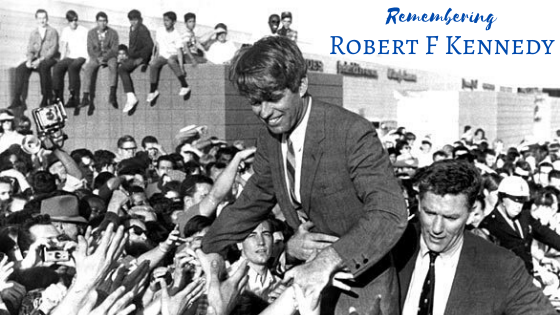
He overcame some of his personal obstacles in order to serve his country. When he joined his brother's campaign for the Massachusetts House of Representatives, one of the other campaign workers said, "Words came out of his mouth as if each one spoken depleted an already severely limited supply." Years later, Bobby would draw thousands to hear him speak. Crowds were eager to catch a glimpse of him. They stole his cuff links and tore his clothes in an effort to have a memento of him.

Bobby also set himself apart from the Kennedy clan by steadfastly adhering to his Catholic beliefs. He was faithful to his wife, cared about the poor, and regularly attended mass. According to Schlesinger, he "was determined to win the $2000 prize offered by Joseph Kennedy to all his children who did not drink or smoke till their twenty-first birthday." Even when married with children, he and Ethel did not have alcohol or ashtrays in their home.

When Bobby decided to run for president in 1968, it was reluctantly, and he was late to the game. A whirlwind campaign began on March 16, 1968, and these last months of Bobby Kennedy's life are an exemplary demonstration of who he was and what his values were.

He did much of what we expect from a politician on campaign. He spoke at universities and had dinners with local political leaders, but he also did plenty of the unexpected. Bobby took the time to visit Indian reservations and held impoverished babies. Crowds lined the streets, not just when he entered a town, but sometimes stretching for miles. And Bobby didn't just wave. He had his car slow down and even stop, often making him late to see 'more important' men. He leaned out into crowds, but to the dismay of his bodyguard, who knelt in the vehicle and held Bobby around the waist to keep him from being torn from the vehicle.

The bodyguard, Bill Barry had his work cut out for him, trying to keep Kennedy safe, while Bobby was insistent that no one be hurt or pushed away. Barry said, "I wanted him to be President of the United States for the sake of my children and generations to come. It was not just a professional job with me." People simply loved Bobby, but they left him bruised and bloody from their grasping.

Bobby was emotional, and this was often revealed in his speeches. Calling for an end to war in Vietnam, he asked one crowd about the things that might have been accomplished by the men who had died. Included in a lofty list that included curing cancer and founding a university, he asked, "Which of them might have taught a small child to read? It is our responsibility to let those men live."

On April 4, the Kennedy caravan was on its way to Indianapolis when they received the news of Martin Luther King Jr's assassination. Concerned for his safety, many discouraged Bobby from speaking. The crowd he was to address was expected to be 70% African-American, and they had not yet heard the news. They learned of the murder from Bobby at a park now memorialized as the Landmark for Peace.

"I have bad news for you, for all of our fellow citizens, and people who love peace all over the world, and that is that Martin Luther King was shot and killed tonight. Martin Luther King dedicated his life to love and to justice for his fellow human beings, and he died because of that effort. In this difficult day, in this difficult time for the United States, it is perhaps well to ask what kind of nation we are and what direction we want to move in. For those of you who are black - considering the evidence there is that there were white people who were responsible - you can be filled with bitterness, with hatred, and a desire for revenge. We can move in that direction as a country....Or we can make an effort, as Martin Luther King did, to understand and to comprehend, and to replace that violence, that stain of bloodshed that has spread across our land, with an effort to understand with compassion and love. For those of you who are black and are tempted to be filled with hatred and distrust at the injustice of such an act, against all white people, I can only say that I feel in my own heart the same kind of feeling. I had a member of my family killed by a white man. But we have to make an effort in the United States, we have to make an effort to understand, to go beyond these rather difficult times."

He then quoted Aeschylus. "In our sleep, pain which cannot forget falls drop by drop upon the heart until, in our own despair, against our will, comes wisdom through the awful grace of God."

 Many major cities in the United States suffered violence and riots that night and in the nights that followed, but Indianapolis was not one of them. Kennedy also called the widow, Coretta Scott King, and asked what he could do to help her, although some discouraged him from getting involved during the campaign. She needed help arranging for her husband's body to be brought home from Memphis to Atlanta. Bobby made the arrangements.

Kennedy's victory speech at Ambassador Hotel
moments before he was shot
At his next campaign stop, Bobby mentioned the rioting. "No martyr's cause has ever been stilled by his assassin's bullet. No wrongs have ever been righted by riots and civil disorders. A sniper is only a coward, not a hero, and an uncontrolled, uncontrollable mob is only the voice of madness, not the voice of the people." But he did not stop there. "There is another kind of violence, slower but just as deadly, destructive as the shot or the bomb in the night. This is the violence of institutions; indifference and inaction and slow decay. This is the violence that afflicts the poor, that poisons relations between men because their skin has different colors. This is a slow destruction of a child by hunger, and schools without books, and homes without heat in the winter."

He also wasn't afraid to speak uncomfortable truths. When a student at a Catholic university pointed out that the draft got blacks out of the ghetto, he didn't hold back. "How can you say that we can deal with the problems of the poor by sending them to Vietnam?" He challenged them, as those with the power to do something, to get up and make changes.

He was serious and driven, but also occasionally revealed a quick wit. Once, when asked what was the difference between him and McCarthy, he joked, "Charm, sense of humor."

People lining the tracks as RFK funeral train passed

What could Bobby Kennedy have done for America if he had not been shot in the early hours of June 5, 1968? It's difficult to imagine the suspense hanging like a cloud over the nation as doctors worked to save his life, only to admit defeat at 1:44am the next day.

Americans had learned to mourn Kennedys less than five years earlier, and they came out in droves again to say goodbye to Bobby. People were so eager to demonstrate their sorrow that two mourners were hit by a train and killed as they tried to touch the train carrying Bobby Kennedy's body to Washington DC. At the Democratic National Convention in August 1968, Ted Kennedy, the youngest and only surviving Kennedy brother spoke.

"If my brother's life, and death, had one meaning above all others, it was this: that we should not hate but love one another, that our strength should not be used to create the conditions of oppression that lead to violence, but the conditions of justice that lead to peace."


Final resting place of Robert F Kennedy at Arlington National Cemetery


~~~~~~~~~~~~~~~~~~~~

Additional Suggested Reading:

Robert Kennedy and His Times by Arthur M Schlesinger, Jr
85 Days: The Last Campaign of Robert Kennedy by Jules Witcover
The Last Campaign: Robert F Kennedy and 82 Days That Inspired America by Thurston Clarke

Saturday, May 30, 2020

RFK and the Decision to Run for President


Looking back more than half a century, most Americans know that Bobby Kennedy was shot while running for president, but not all realize that it was an agonizing decision, that he was late to the game, and that he had a great chance of being victorious. Kennedy could be a polarizing figure. Because he worked tirelessly and held staunchly to his beliefs, those who didn't agree with him though him ruthless and inflexible. However, those who agreed with his vision for a better America adored him and were intensely devoted to him.

Many Americans to this day remember Robert F Kennedy as the best president we never had, but he almost didn't even run in 1968. Most of his family and friends encouraged him to wait until 1972, so what changed his mind?

John and Robert Kennedy
John F Kennedy said his brother Robert was, "A puritan, absolutely incorruptible. Then he has this terrific executive energy." This summary of Bobby demonstrates why he struggled with the decision to run for president. He needed to know that it was the right thing to do, but answering that questions wasn't simple. Lyndon Johnson, who had succeeded JFK was a sitting president and member of Kennedy's own party. It would take a lot to justify dividing the democratic party to run against him.

Bobby believed that Johnson was throwing away the progress that had been made during JFK's administration. "He knows all about politics and nothing about human beings," he succinctly described Johnson. As New York's junior senator, RFK had traveled around the country visiting the poor. Whether it was in Brooklyn, the Mississippi delta, Indian reservations, or migrant worker camps in California, Bobby found a way to connect to the people in a way that Lyndon Johnson never could - not that he ever tried.

RFK with Charles Evers
But that was not enough to cause Bobby to run for president in 1968. He couldn't divide the party because of personal dislike and disagreement. But there was also the Vietnam War, Civil Rights, and Eugene McCarthy.

McCarthy had already taken the step of defying the party norm to run against the president on an anti-war platform. He was getting more support than many had suspected he would, and the Kennedy crew knew that Bobby would be even more popular. Except that it meant Bobby would be choosing to divide the party even further.

Neither McCarthy nor Johnson had the relationship with the poor and downtrodden like Kennedy. Johnson's failure to react to race riots in 1967 helped prompt Bobby into action. The people dying of violence and hunger were not just numbers to him, and when he spoke people knew he really cared. Could he leave them to another four years of Johnson policy? Was McCarthy likely to be better? Certainly, republican challenger, Richard Nixon, was not going to be a champion for the black or the poor.

Then the Tet Offensive began in January 1968. More than 100 cities and camps in South Vietnam were attacked, killing American soldiers and demonstrating the weakness of their position after years of involvement. RFK was livid that the lives of young - and primarily poor - men were being wasted on a war that the South Vietnamese didn't seem to be as invested in as they should have been. The vulnerability of US troops in Vietnam exposed the truth of how far from victory they really were. Bobby believed these young men deserved to be brought home.

RFK and Jackie after JFK assassination
Still, the decision wasn't simple. Some encouraged RFK to run while his political capital gained from the memory of his brother was high. Others thought he might have more accomplishments of his own to run on by 1972. Any political capital he had from any source might be lost if he ran but didn't win. He felt that he had a duty to run because it was the right thing to do to try make a positive difference, because he couldn't in good conscience endorse Johnson or McCarthy, and because he wanted to help people. The ambition to help others was always a greater incentive to action with Bobby Kennedy than political strategy. "Let's face it," he said to one reporter, "I appeal best to people who have problems."

In 1960, John F Kennedy had announced his intention to run for president in the caucus room of the Old Senate Building. On March 16, 1968, in the same room and at the same age, Robert F Kennedy did the same. Afterward, Jacqueline Kennedy told Arthur Schlesinger, "Do you know what I think will happen to Bobby? The same thing that happened to Jack."


~~~~~~~~~~~~~~~~~~~~
Additional Suggested Reading:

Robert Kennedy and His Times by Arthur M Schlesinger, Jr
85 Days: The Last Campaign of Robert Kennedy by Jules Witcover
The Last Campaign: Robert F Kennedy and 82 Days That Inspired America by Thurston Clarke

Saturday, May 23, 2020

The Compassion of Robert Kennedy


One of the characteristics that made Bobby Kennedy so popular was his vast compassion. Although he came from a wealthy Irish Catholic family, he seemed capable of understanding the hardships and trials of others in situations he had never experienced. Whether he was cradling an emaciated infant in Mississippi, listening to the concerns of migrant workers in California, or visiting an impoverished Indian reservation, Kennedy "could move from world to world and never be a stranger anywhere."

RFK's opponents claimed that he was ruthless, but those who were closest to him insist that it was a tireless ambition to improve the world that sometimes made him appear ruthless. Robert Kennedy was passionate about helping people and couldn't understand why more people didn't look at the world the same way. He was a devout family man, and when he saw starving children, he couldn't help thinking of how he would feel if he were that poor mother or father unable to feed their child. Even the Kennedy family nurse said that Bobby was the "most thoughtful and considerate of all the Kennedy children."

Robert F Kennedy with child
at Pine Ridge Reservation
Bobby made a point of visiting his own disabled father each week, though he had a loaded schedule and ten children of his own (his 11th was born after his death), but his compassion wasn't limited to his own family. He visited nursing homes and held the hands of the dying. Bobby and Ethel held a Christmas party each year for children living in an orphanage, and he seemed to be able to instantly connect with children of all ages and races wherever he went.

According to Arthur Schlesinger, when Kennedy visited Brazil two years after his brother's death, "He gathered barefoot children around him in a forlorn community center named for John Kennedy," and encouraged them, "President Kennedy was most fond of children. Can I ask you to do a favor for him? Stay in school, study hard, study as long as you can, and then work for your city and Brazil." He left deflated that he couldn't do more for those children.

Compassion for a child inspired one of Robert Kennedy's longest lasting legacies. While touring an impoverished neighborhood in Brooklyn, Bobby asked a mother what had happened to cause her daughter's face to be horribly disfigured. When he heard that rats had attacked her as she slept as a baby, RFK was motivated to action. The Bedford-Stuyvesant Restoration Corporation was soon born, and it exists to this day, creating better lives for the residents of a once devastated neighborhood.

Robert Kennedy's trip to Mississippi Delta - 1967
Photo Credit: Jim Lucas
Kennedy ordered the investigation of labor camps in California when he found filthy children covered in sores living in old school buses. He entered the squalid shacks of those living in the Mississippi Delta, then he fought for relief for those children in Washington. He did not shy away from the grime and illness. He held sick, dirty children and promised that he would do more.

Charles Evers, brother of murdered civil rights leader Medgar Evers, remembered Kennedy holding a weak, malnourished black child with tears running down his face, asking, "How can a country like this allow it? Maybe they just don't know." Evers said, "No other white man in America would have come into that house."

Remembering Robert F Kennedy makes me wonder what the world could be like if we were all just a little bit like him, if each of our hearts broke when we saw the pain of others, if we all yearned to help those less fortunate than ourselves. We need not be heroes, just compassionate everyday people.

"Each time a man stands up for an ideal, or acts to improve the lot of others, or strikes out against injustice, he sends a tiny ripple of hope, and crossing each other from a million different centers of energy and daring those ripples build a current which can sweep down the mightiest walls of oppression and resistance." ~ Robert F Kennedy


~~~~~~~~~~~~~~~~~~~~
Additional Suggested Reading:

Robert Kennedy and His Times by Arthur M Schlesinger, Jr
85 Days: The Last Campaign of Robert Kennedy by Jules Witcover
The Last Campaign: Robert F Kennedy and 82 Days That Inspired America by Thurston Clarke

Saturday, May 16, 2020

RFK and Bedford-Stuyvesant


Robert F Kennedy was a liberal democrat with a remarkable skill for understanding problems plaguing the poor. However, he did not believe that welfare payments were the most effective solution, especially because of the way payment calculations discouraged family unity. With single mothers able to receive higher payments than households where the husband was present, RFK was concerned that the government was incenting family disintegration. Kennedy believed the better long term solution was to create comprehensive programs specific to and led by localities rather than the federal government.

Bedford-Stuyvesant is the best example of Robert Kennedy's work in this area. Through this project, RFK was able to put his ideas to the test. He believed that it was better to provide people with jobs than government hand-outs. He believed that the best way to improve a community was by getting those directly affected involved with the changes. And he believed fervently in the value of education. The plan for Bedford-Stuyvesant touched all the bases and was a comprehensive strategy to improve the neighborhood from the inside out.

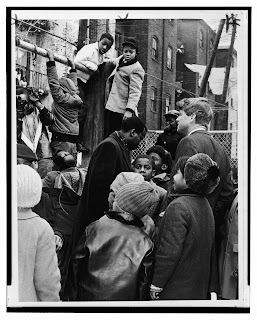
Public Domain Photo by Dick DeMarsico
Robert Kennedy speaks with boy during tour
of Bedford-Stuyvesant in 1966.
A neighborhood in Brooklyn, "Bed-Stuy" was impoverished by the 1960's, but few besides Robert Kennedy took much notice. High unemployment and crime combined with racism and failing school districts to create a neighborhood awash in poverty and hopelessness. In February 1966, RFK paid Bedford-Stuyvesant a visit. At that time, approximately 450,000 people lived in the crowded neighborhood, 82% were black and 12% Puerto Rican.

Robert Kennedy was the junior senator from New York at the time, and some Brooklyn leaders doubted his sincerity. However, he quickly convinced those in the community that he understood their predicament and was there to help, not just for the photo-op. Within months, Kennedy had created a team with representatives from Ford, IBM, Welch's, and several other companies and organizations to tackle the issues Bedford-Stuyvesant was facing.

The team was bipartisan, including New York City's republican mayor and the senior senator from New York, republican Jacob Javits. The result of their collaboration was the Bedford-Stuyvesant Development and Service Corporation (now known as the Bedford-Stuyvesant Restoration Corporation). Kennedy stated that, “The program for the development of Bedford-Stuyvesant will combine the best of community action with the best of the private enterprise system. Neither by itself is enough, but in their combination lies our hope for the future.” RFK continued his involvement in the project until he began his 1968 presidential campaign.

Trash was cleared from vacant lots. Homes in need of repair were renovated, and affordable mortgages were made available. Space was cleared for community areas, and an empty milk bottling plant was made the new home of the Bedford-Stuyvesant Restoration Corporation. Through federal grants and business investments, legal help, tax preparation services, and work-study programs were made available. Residents were hired for restoration work, and a large majority of those workers found full time employment in construction when the Bedford-Stuyvesant project was complete. New businesses were opened by neighborhood residents, and employment rates slowly improved.

Public Domain photo of RFK
touring Bedford-Stuyvesant
More than half a century has passed since Kennedy's initial visit to Bedford-Stuyvesant, and in that time the neighborhood has participated in its own revitalization. Although they have experienced inevitable setbacks, the results have included education programs, job training and placement, residential renovations, and an art academy. The revitalization effort improved the community while providing jobs. Because of the Bedford-Stuyvesant Restoration Corporation, residents of the neighborhood enjoy greater quality of life and increased self-sufficiency.

Thanks to its rows of historic brownstone homes and the decades of revitalization efforts, Bedford-Stuyvesant started to become a more desirable address in the 2000's.

Robert Kennedy was passionate about the success of Bedford -Stuyvesant and what that success might mean to other poor neighborhoods. He once stated that, "If I wasn't the United States senator, I'd rather be working in Bedford-Stuyvesant than any place I know."

Kennedy hoped to see other impoverished neighborhoods benefit from the Bedford-Stuyvesant example, but his plans were cut short when he was killed on June 4, 1968. Others have applied the Bedford-Stuyvesant strategy to a wide variety of urban neighborhoods. Creating a sense of community and creating jobs while improving the living standards of a neighborhood continues to be a more fulfilling solution to poverty than cash welfare programs.

~~~~~~~~~~~~~~~~~~~~

Additional Suggested Reading:
Robert Kennedy and His Times by Arthur M Schlesinger, Jr
85 Days: The Last Campaign of Robert Kennedy by Jules Witcover
The Last Campaign: Robert F Kennedy and 82 Days That Inspired America by Thurston Clarke