Monday, March 14, 2022

The Unfortunate Catherine Dickens

I am happy to welcome Brenda W Clough to the blog today! She is a prolific writer in several genres and a fellow member of the Historical Writers Forum, where we are celebrating Women's History Month. Brenda shares with us the darker side of Charles Dickens - how he treated his wife.

Welcome, Brenda!

~ Samantha

~~~~~~~~~~~~~~~~~~~~~~~~~

The Unfortunate Catherine Dickens

Guest Post by Brenda W Clough

He was famous, but Charles Dickens was a difficult husband. There was that whole writing thing, of course, the twenty novels that are part of the foundations of English literature, the thousands of articles and letters to newspapers, the founding and editing of a couple major magazines, the campaigning for social justice and the rights of the poor. 

But his wife Catherine also had to live with him. We would describe him as a micromanager. For many years he insisted on doing the grocery shopping, not something that gentlemen did in the mid-19th century. He made all the housing and home décor decisions. And he fathered ten children with Catherine. 

So in 1857, when Charles fell in love with a pretty 20-year-old actress, Catherine was in big trouble. Divorce was legal, but impossible. The laws were lopsided, heavily favoring the husband. She would have to prove more than adultery. She’d have to prove brutality or some other extenuating circumstance. He was the social conscience of Britain – no judge would believe it.

Meanwhile Charles was also frustrated. He’d been discontented with his marriage for a few years already. By writing classics like A Christmas Carol and Oliver Twist he’d set himself up as a pillar of Victorian morality, a defender of the oppressed. To divorce the mother of his ten children after over 20 years of marriage would make him look like a skunk. His career, his entire social status, was built upon a perception of rectitude. He couldn’t do it.

So Charles did it the dirty way. He began a campaign in letters and conversation with friends, creating excuses to get rid of his wife. Catherine was a bad mother. She was an uncongenial partner, fat and no longer pretty. They hadn’t had sex in years.  She never did any of the work around the house. She was nervous, semi-invalid, had the vapors, was probably insane. 

He was Charles Dickens, the most famous author of his time. The PR campaign he geared up was utterly convincing – until you actually looked at the situation. Ten children, could you really believe that they weren’t congenial partners? And, hello – who wouldn’t lose her figure, after ten pregnancies? Which would also account for being semi-invalid. Many observers agreed it was pretty seedy of Charles, to ditch his wife of 22 years for a mistress the same age as his daughter. Even his best friends urged him to stick with Catherine. Enough of social circle believed her, not him, to split literary London into hostile camps.

Charles’s goal was to get Catherine out of the house and out of his life. There was no way that she could stand up against his writing powers. And the hints of mental problems were a warning. More than one obstreperous woman in the period had been railroaded into an asylum by relatives. A faked diagnosis of insanity is the backbone of THE WOMAN IN WHITE, the novel by Wilkie Collins. 

So Catherine folded, signing a settlement in 1858 that conceded they were separated. Charles could afford to set her up in a separate household in London and pay her 600 pounds a year. He kept the family home and the kids. Only the oldest, Charles Jr., was of age and able to make his own decisions. Significantly, he chose to live with his mother. Catherine declared to relatives that she still loved Charles. 

Most importantly, Charles hung onto his reputation. People mostly believed the famous writer, not his chubby wife. Catherine retreated into a secluded life, seeing only family and friends. Meanwhile Charles did worldwide tours, reading aloud from his works to packed audiences. He continued to write novels until the end of his life. He retained his mistress Ellen Ternan, who left the stage to be with him. 

In spite of her public humiliation, Catherine still held the ace card. A legal separation wasn’t divorce. Catherine was still Mrs. Charles Dickens, his legal wife. Charles couldn’t marry Ellen, couldn’t take her to parties or into his social life. And when he died, Queen Victoria sent the condolence telegram to Catherine, not Ellen. Catherine’s final move was to leave all her letters from Charles to the British Library. They were written proof that she wasn’t insane, wasn’t a bad mother. And in them Charles declared over and over that he loved her.


Additional Reading:

Louisa Nottidge was one of the women actually incarcerated in an asylum by her relatives.  

A 2011 biography of Catherine Dickens goes into much more detail.  

There is also a biography of Ellen Ternan which was made into a movie. 


Monday, February 28, 2022

Women in History

Historical Writers Forum presented a great talk on Women in History over the weekend that I was honored to participate in. Missed it? That's alright. Watch it now!


Friday, February 25, 2022

Colonial Dinner

A couple of weeks ago, my husband said, 'LaSalle Grill is having a Colonial Wine Dinner. Do you want to go?' I paused in whatever I was writing. Was it possible that I just heard that perfect combination of words come together? 

He showed me the menu.

Oh my gosh, yes. Make the reservations.

LaSalle Grill is our favorite place in the area. The last time we went was our twenty-fifth anniversary, and they treated us like we were the first people on earth to manage to be married that long. 

I was anticipating this dinner all day, almost wishing I had a 17th century dress to wear when I sampled dishes like peanut soup and madeira braised venison. While I am no culinary expert, I would love to share this experience with you, my dear reader.


The first course was cream of peanut soup, which I was quite curious about. I love trying interesting foods, like burgers on donut buns or other crazy combinations that chefs come up with. And it had chicken in it. Chicken and peanuts - what would that be like?

Well, I'll tell you. It was yummy with a pleasant creamy peanut butter flavor that wasn't overwhelming. It made me wonder if Abigail Adams made peanut soup for John when he came in chilled from his travels.


Second was butter poached blue crab on johnnycake with bacon jam. Now there's a dish with lots of delicious components, and it was just as amazing as you're probably thinking it was. My husband and I joked that we needed bigger servings of this one, but we still had five courses to go.

It was paired with an organically brewed Michigan apple cider that probably tasted a lot like what our ancestors used to drink.


Third was an oyster. I know I've said I'm an adventurous eater, but seafood is not my favorite and I had never before tried oysters. But this was an evening for trying new things, and I was intrigued by the ginger pickled watermelon rind which accompanied it.

I am glad I tried oyster . . . but I probably won't be ordering a plate full of them. On the other hand, the watermelon, which was chopped up sort of like a relish, was quite good! The oyster was appropriately paired with a dry riesling from the Finger Lakes region of New York.

I started thinking about how people used to be able to forage for oysters along the shores of Manhattan Island. Was this still possible during the American Revolution? Did hungry soldiers in the Continental Army supplement their poor army fare with fresh oysters? Another thing to look into.


Then came the boar chop with braised greens and crackling bread. All of this was amazing, as was the Williamsburg adagio with which it was paired. Is this the kind of thing Dolley Madison served at her 'squeezes' at the White House? I must find out.


I had no idea what kind of meat would even be in squab pie - apparently pigeon - and it was delicious. The flavors of sage and onion with that flaky crust . . . it was like Thanksgiving at grandma's house. And the cabernet franc with it was our favorite of the evening.

I bet George Washington loved squab pie. The Mount Vernon Inn Restaurant and Fraunces Tavern both sell a chicken pot pie with his recommendation. Trying this dish made me wonder if the chicken pot pie is a modern substitute.  


The madeira braised venison osso bucco was my husband's favorite, but I may have had my mind too much on the soon-to-come apple brown betty. I'm from Michigan, so I've had venison, but this wasn't like that. I actually double-checked the menu, because it had the milder flavor of beef. The toasted walnut samp was my favorite part of this dish, and I made a note to myself to find out what type of people would have eaten this. Was it an upper-class delicacy or something everyday housewives were setting before their families?


The moment I had been waiting for - the apple brown betty. Wow! This was so good. Maybe caramel sea salt gelato wasn't served in the 1700s (or maybe it was, I'll have to look that up), but I know Martha Washington and Dolley Madison served ice cream so close enough. This was the best dessert I've had in ages, and I was so excited to try the madeira, knowing what a popular drink it has been through the ages. 

How many of history's big events have occurred with glasses of madeira passed around? It tasted like sweetened walnuts and was more pleasant than I expected. Raise a glass!


My thanks to LaSalle Grill for putting on this event. As a writer, there is nothing like truly experiencing what it was like to live in another era, and trying these foods has my mind buzzing with ideas!

Monday, January 31, 2022

Aelfgyva: The Mysterious Woman of the Bayeux Tapestry

 Did you miss the Historical Writers Forum talk on the identity of Aelfgyva? Watch it now and decide for yourself - who was the real Aelfgyva?

Tuesday, January 11, 2022

Legend of Nancy Morgan Hart


The history of women during the American Revolution can be challenging to separate from myth and legend. Unlike men of the era, women's daily life and courageous exploits were not thoroughly documented and reported. We may never know if Sybil Ludington made her famous ride or if Agent 355 even existed. Nancy Morgan Hart was another woman who lived during the American Revolution, but how many of the stories about her are true?

Ann Morgan (called Nancy) was born around 1735 and married Benjamin Hart in 1760. She was a woman of the Georgia frontier, capable of managing a household and all that entailed in the wilderness far away from sources of supplies. Nancy cooked, cleaned, made soap, and sewed clothes. She also raised livestock, planted crops, and hunted deer. All while raising eight children. She is remembered as a large robust woman. Some reports put her at 6' tall, towering over most men of the era.

Nancy Hart has been memorialized as an American patriot with streets, lakes, and a Georgia county named after her. Enthusiasts have attempted to claim Nancy's shared ancestry with Daniel Boone and Daniel Morgan, though there is no proof of either. These honors came decades after the American Revolution and after Nancy had passed away, taking her memories with her.

Variations on Nancy's story include her spying for the patriots or helping an American spy escape loyalist troops. What is the same in each version of these stories is that Nancy was brave and brutal when it came to dealing with the enemy.

One story has Nancy notice a British spy peering through a hole in her wall while she was making soap. Demonstrating lethal marksmanship, she tossed a ladle of the boiling mixture at the hole, sending the man away blind and wounded. 

In the early 20th century, the remains of six men were discovered in the area where the Hart cabin was believed to have once stood. This is the best evidence that at least one story told about Nancy Hart is true. 

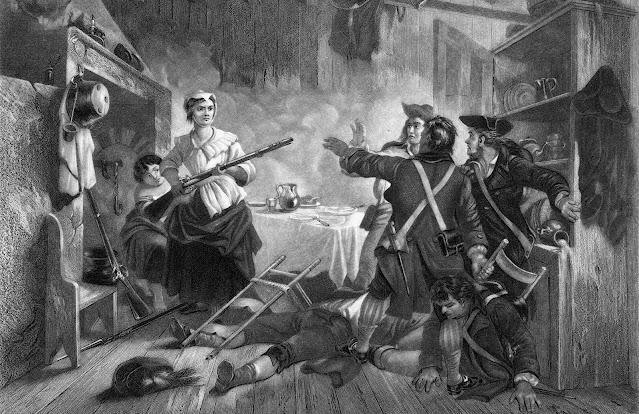
According to this legend, six British troops stopped at the Hart cabin either looking for a spy or demanding food. Finding Nancy uncooperative, they shot her last turkey and ordered her to cook it for them. She seemed to be submitting while plying them with alcohol and stealing their weapons. When one of the soldiers realized what was happening, Nancy shot him and sent her daughter (or a slave) to neighbors for help. When the neighbors arrived, they hanged the remaining soldiers. 

Were those soldiers the men whose remains were unearthed more than a century later?

Other folklore puts Nancy fighting in the battle of Kettle Creek, acting as a sniper as British attempted to cross the Savannah River, and dressing as a man to serve as a spy and/or soldier. The fact that stories like this exist is good evidence that Nancy Hart was a formidable woman who probably had some brave interactions with British loyalists while her husband was away fighting, but we may never know exactly what happened on the Georgia frontier. 

Nancy probably died between 1825, when the first stories about her are documented in local newspapers, and 1830, the date chosen for her grave marker when erected by the Daughters of the American Revolution in the early 20th century. 


~~~~~~~~~~~~~~~~~~~~~~

Additional reading: 

"Nancy Hart, Georgia Heroine of the Revolution: The Story of the Growth of a Tradition" in The Georgia Historical Quarterly, Vol 39, No 2 (June 1955) by E Merton Coulter


Women of the American Revolution by Samantha Wilcoxson is available from Pen & Sword History.

Also available at AmazonBarnes & NobleBook Depository, and your favorite bookseller.

Now you can listen to Women of the American Revolution on Audible or audiobooks.com.