Friday, May 5, 2023

Deborah Sampson: A Woman at War


An excerpt from Women of the American Revolution:

A soldier’s life was dangerous. If one was not injured or killed in combat, they still had the unsanitary camp conditions to deal with. High casualties can be attributed to disease, cold, and heat rather than any British weapon. Reasons women might disguise themselves in order to fight were numerous, despite the risks. Those who were enslaved or indentured servants might see it as a path to freedom, especially if they were light complexioned enough to claim Caucasian ancestry once away from those who knew of their origins. Women might attempt to leave behind a shameful past or hide a premarital pregnancy. Like Deborah, they might hope to escape poverty or the insecurity of being a single woman in a nation at war. Some fled abusive husbands or parents, and, just as their male counterparts did, some women wanted to join the war effort due to passionate patriotism. 

Whatever was Deborah’s inspiration, in April 1782 she enlisted in the army, claiming to be Timothy Thayer. Discovered and in fear of prosecution, she fled her native Middleborough, Massachusetts. Whether she had intended to honor her enlistment or whether she, like many others, was hoping to slip away with her signing bounty in hand, is unknown. But when she enlisted a second time on 20 May 1782, this time as Robert Shurtliff, a name common enough in the area to allow Deborah to remain anonymous, she accepted a bounty of £60 and joined new recruits at Worcester for muster.  The American victory at Yorktown had taken place the previous October, but three-year recruits were still being signed on in the case that a treaty did not follow as expected. After all, it was not the first American victory of the war and news took weeks to cross the Atlantic. The Continental Army could not yet rest.

Read more about Deborah and her life after the war in Women of the American Revolution! It is available at Pen & SwordAmazonBook DepositoryBarnes & Noble, or your favorite book retailer. 


Also available now at Audible and audiobooks.com!

You can also find more articles here.

Join me on your preferred social media for daily fun facts, on this day in history posts, and lots of pictures!

Facebook

Instagram

Twitter


Saturday, April 22, 2023

But One Life: An Excerpt


On 22 April 1775, the coastal town of New London, where Nathan Hale was a school teacher, responded to the news of battle at Lexington and Concord. The following is an excerpt from But One Life, based on historical records that note Hale stepping up to speak to the men who had gathered.


A town meeting was called to discuss New London’s response to the battles at Lexington and Concord. The British were besieged in Boston, and some believed we should take the fight directly to them. Would it send them scurrying across the ocean or bring down the awful wrath of the greatest military in the world?

Of course, there were also those who wished to wait for more news or a response from London or whatever that something was that would spur them into action. I had read enough history to know that timidly waiting for the right moment rarely led to victory. Though I was young and not native to New London, I stood.

‘Let us join our brothers in arms in their stand against tyranny. I will go. Who is with me?’

I was surprised how many men loudly roared their agreement once one had stood to boldly speak. I had to yell to be heard over them.

‘Let us march at once and never lay down our arms until independence is won!’

I could scarcely believe myself, but I felt infused with the strength of my friends and loved ones. It was for their liberty and peace that I was willing to fight.


Sunday, April 16, 2023

Peggy Shippen's Lost Gamble


Peggy Shippen Arnold was rarely suspected of playing a role in her husband's treason. She can thank the 18th century mindset that made it practically unthinkable for a woman to do such a thing. Peggy may have even been the mastermind behind Benedict Arnold's attempt to hand West Point over to the British. That plan failed, and British Major John Andre ended up executed, but what about the Arnolds? What happened to them after they ended up on the losing side of the war?

From Women of the American Revolution:

"The British surrendered at Yorktown on 19 October 1781. After betraying their country, the Arnolds found themselves on the losing side. As they packed to leave for London, a city Peggy had never visited, she must have wondered if she would ever see her family again. They sailed on 8 December 1781. The Arnolds were not alone. Thousands of loyalists and African Americans fled the new country that was less than welcoming to them.

Peggy was well received in London. Called the ‘Fair American,’ she found her place in society, and she may have felt a bit like her old Philadelphia days if not entirely vindicated in the decisions she had made. The Arnolds were presented to King George and Queen Charlotte. They were rewarded generously for their service, even if General Arnold had not provided the British with the victorious engagement for which they had hoped. A pension paid to Peggy separate from the money paid to her husband is further evidence of her active involvement with the treachery that had left AndrĂ© dead."

Benedict Arnold tried his hand as several money making schemes, one of them in Canada. In 1786, he brought Peggy and their children to join him in New Brunswick in the hope that they would find success and happiness there.

More from Women of the American Revolution:

"In St John, New Brunswick, Peggy made a comfortable home for her family, bringing furnishings from London and her indominable spirit. Arnold collected his entire family at their new home, including his spinster sister, Hannah, and his older children. It is unknown at what point after her arrival that Peggy learned of another child her husband had sired. One must wonder after all she had suffered at his side how Peggy felt to discover that Arnold had fathered a child with a woman in St John during his first trip to Canada. At just the point when their life seemed to be turning around, Arnold’s affair drove a wedge between he and his wife. Two months after arriving in St John, Peggy gave birth to another son, named George like the son who had died, a common practice at the time. Had Peggy already learned of her husband’s infidelity? One can imagine how much it might change her state of mind as she recovered from childbirth, depending upon when this realization was made."

The business in Canada failed, and, with Peggy and the children returned to England, Arnold decided to try his luck in the Caribbean, but he was never satisfied with his endeavors.

More from Women of the American Revolution:

"It is difficult to guess at Peggy’s feelings when Benedict Arnold died on 14, June 1801. He had been irrational, unsuccessful, and unfaithful, but she had stood by him, mostly uncomplainingly. Being a widow had its own challenges, but Peggy addressed them head on. Peggy’s key concern was her finances. Her husband had created a complicated web of business contracts and debts that Peggy was responsible for unwinding as executor of his estate. The fact that Arnold had named his wife executor is evidence of her intellect and his trust in her, as few eighteenth century wives were selected for this role that was typically reserved for men. Peggy had five children besides Arnold’s older sons and illegitimate son in Canada, who he had not left out of his will. One can only imagine what Peggy thought of her husband of twenty-two years including his 14-year-old bastard in his will while she scrambled to ensure her own children’s futures. She refers to him in letters to her sons simply as ‘the Boy,’ though she knew his name was John Sage. ‘The Boy who is with you ought to be taught, by his own labor, to procure his own livelihood; he ought never to have been brought up with any other ideas.’" 


Read more about Peggy Shippen Arnold and her struggles after the death of Benedict Arnold, as well as several other amazing 18th century ladies, in my newest book, Women of the American Revolution. It is available at Pen & SwordAmazonBook DepositoryBarnes & Noble, or your favorite book retailer. 

Also available now at Audible and audiobooks.com!

You can also find more articles here.

Join me on your preferred social media for daily fun facts, on this day in history posts, and lots of pictures!

Facebook

Instagram

Twitter


Monday, March 27, 2023

Will the real James Hamilton please stand up?

As many of my dear readers know, I am currently working on a biography of James Alexander Hamilton, son of America's first Treasury Secretary and pretty interesting guy in his own right.

James Alexander Hamilton

Since he lived from 1788-1878, James observed a chaotic and important segment of US history - the entire Early Republic era, and, being the son of a Founding Father, he had loads of important people with whom he corresponded on all the vital issues of the day. One of these people was Martin Van Buren, and one of these issues was the scandal of Peggy Eaton, also known as the Petticoat Affair.

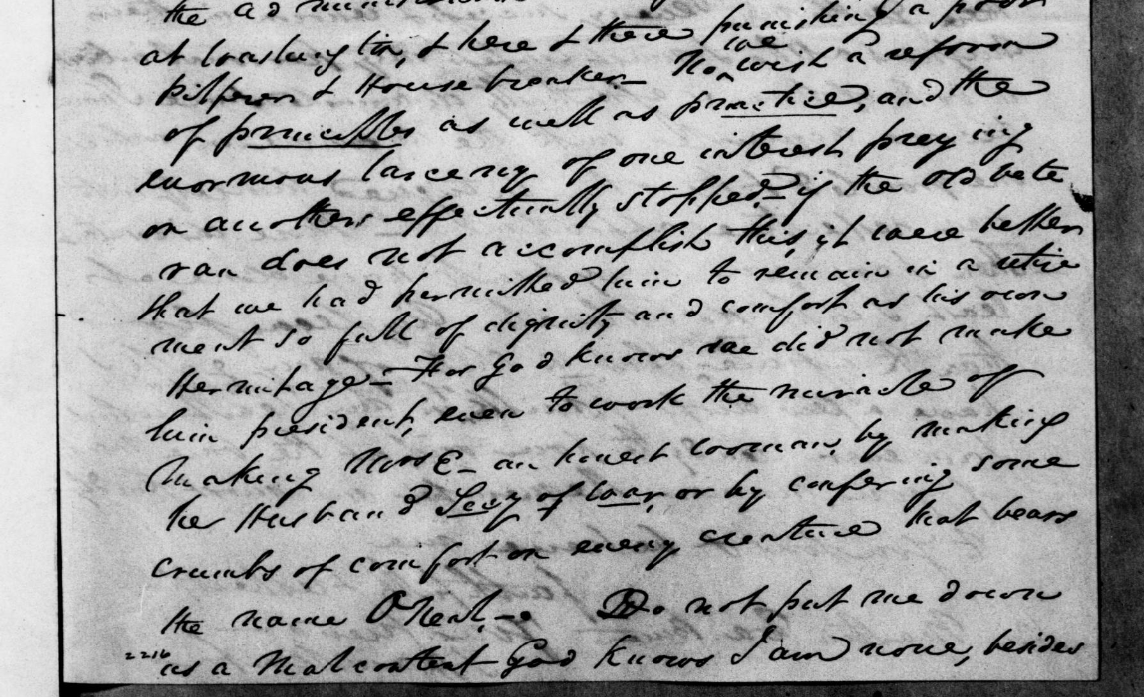
I was reading John Marszalek's book about this incident when I noticed a quote from James that did not ring true to me.

"For God knows we did not make him president to work the miracle of making Mrs E an honest woman." (The Petticoat Affair by Marszalek, p85)


Excerpt of letter including quote about Mrs E
LOC: Image 328 of Martin Van Buren Papers: Series 2, General Correspondence, 1787-1868; 1829; 1829, Apr. 16 - Aug. 14 | Library of Congress (loc.gov)

While plenty of people made comments similar to this about Margaret Timberlake Eaton, who was married to Andrew Jackson's Secretary of War, John Eaton, I wasn't sure that James A Hamilton had. I have read dozens of letters written by James, and this just didn't fit. He tended to be one who didn't record a lot of negativity, though he admittedly did refer to ‘great distrust of the fitness of the two Secretaries to manage the affairs of this great Country; - a distrust which, with all my regard for the President, I cannot help indulging.’ (Reminiscences of James A Hamilton, p135)

So, I started searching for the letter to which Mr Marszalek referred in his notes as the source of this quote. 'James A Hamilton to MVB, July 16, 1829' at the Library of Congress. This took me to a 435 page file of random correspondence of Martin Van Buren dated April 16 - August 14 of 1829, so I started slowly flipping through, watching for the correct date and the handwriting that had become familiar to me as belonging to James.

This is where I encountered the first bit of evidence that my doubts were well founded. The letter dated July 16 did not look like the ones I had been painstakingly combing through for months. I looked at the end for the familiar "JAH" that James often signed off with when writing to friends.

No, this letter appeared to say "J Hamilton" with some extra letters I couldn't immediately identify. 


Final page of letter with Mrs E quote


James always signed with the "A" of his middle name, whether writing out his signature or using initials. This "A" stood for "Alexander" - his father's name, and a father James was very proud to claim. I had never seen him write his name without it.


Signature of James A Hamilton

This is when I began trying to discern what other name it could be, and I remembered that another James Hamilton had sometimes come up when I was searching for "mine." I looked for letters written by South Carolina governor James Hamilton - and there it was. A matching signature with "Jr" at the end. Those were the letters I had been trying to identify, and this was the author of the letter to Martin Van Buren on July 16, 1829. I have included them both, so you can compare for yourself.

Letter signed by James Hamilton Jr of South Carolina

In case any of you have wondered how a historical writer spends their time, now you know! I have not been able to find a way to contact historian John Marszalek, and, I suppose, to most readers of his book the difference is not material, but I felt that I had solved a great mystery!

Saturday, March 25, 2023

Mercy Otis Warren: Historian of the American Revolution


 As a wife and mother, Mercy Otis Warren serves as an example of what women were forced to sacrifice during the American Revolution. Since she was also an accomplished writer and historian, she provides us with a unique view of the era. At a time when women were not expected to understand, let alone comment on politics, Mercy wrote poems, plays, commentaries, and eventually a three volume history of the United States. Besides her well-known brother, James Otis, Mercy corresponded with many great names of the day and collected newspapers, diaries, and anything she could get her hands on to document the birth of a nation.

From Women of the American Revolution:

However, Mercy could not entirely devote herself to patriotic politics the way men like John Adams did. She was a wife with a household to maintain. More importantly, she was the mother to five sons. Much as she supported independence from an early point in the Revolution, Mercy was afraid of what might become of her boys if called upon to fight. She wrote to Abigail Adams, ‘not to mention my fears for him with whom I am most tenderly Connected: Methinks I see no Less than five sons who must Buckle on the Harness And perhaps fall a sacrifice to the Manes of Liberty Ere she again revives and spreads her Chearful Banner over this part of the Globe.’

Her fears were not assuaged when General Thomas Gage replaced Hutchinson as the governor of Massachusetts, placing the colony under martial law. His authority under the Coercive Acts, which had been passed in response to the destruction of the tea, left colonists feeling vulnerable and without a voice. Boston Harbor lay empty, relieving many of their livelihood, and tensions rose as many, including Mercy, wondered what would come next.

What came next was armed conflict. The Warrens were forced to flee their home.

James rushed home, and the Warrens set out for Rhode Island. Mercy later wrote in her History that ‘A scene like this had never before been exhibited on her peaceful plains; and the manner in which it was executed, will leave an indelible stain on a nation, long famed for their courage, humanity and honor.’

James and Mercy encountered many other travelers, some witnesses of the fighting at Lexington and Concord. One told them of a story so harrowing that Mercy included a retelling of it in a letter to a friend. ‘I saw yesterday a gentleman who conversed with the brother of a woman cut in pieces in her bed with her new born infant by her side.’ Accounts such as this must have caused internal struggle in the patriotic but fearful Mercy.

Mercy coped with fear and anxiety throughout the war, but she found refuge in her faith and her writing. In 1805, she published her History of the Rise, Progress and Termination of the American Revolution: Interspersed with Biographical, Political and Moral Observations. She was seventy-seven at the time. Mercy lived long enough to see war come again to the United States in a conflict known by many names, but she died before the conclusion of the War of 1812, never knowing if the young nation was victorious in its Second War of Independence.


If you would like to learn more about Mercy Otis Warren and other amazing 18th century ladies, please consider my newest book, Women of the American Revolution. It is available at Pen & SwordAmazonBook DepositoryBarnes & Noble, or your favorite book retailer. 

Also available now at Audible and audiobooks.com!

You can also find more articles here.

Join me on your preferred social media for daily fun facts, on this day in history posts, and lots of pictures!

Facebook

Instagram

Twitter