Thursday, May 25, 2023

If you could change history, would you?


We all know the past is the past, but what if you could change history?

We asked eight historical authors to set aside the facts and rewrite the history they love. The results couldn’t be more tantalizing.

What if Julius Caesar never conquered Gaul?

What if Arthur Tudor lived and his little brother never became King Henry VIII?

What if Abigail Adams persuaded the Continental Congress in 1776 to give women the right to vote and to own property?

Dive in to our collection of eight short stories as we explore the alternate endings of events set in ancient Rome, Britain, the United States, and France.

An anthology of the Historical Writers Forum.

Get it for 99c on Amazon or read it FREE with Kindle Unlimited!

Meet the Authors:


Samantha Wilcoxson

Samantha Wilcoxson is an author of emotive biographical fiction and strives to help readers connect with history's unsung heroes. She also writes nonfiction for Pen & Sword History.

Samantha loves sharing trips to historic places with her family and spending time by the lake with a glass of wine. Her most recent work is Women of the American Revolution, which explores the lives of 18th century women, and she is currently working on a biography of James Alexander Hamilton.

Website


Sharon Bennett Connolly

Historian Sharon Bennett Connolly is the best-selling author of five non-fiction history books, with a new release coming soon.

A Fellow of the Royal Historical Society, Sharon has studied history academically and just for fun – and has even worked as a tour guide at a castle. She writes the popular history blog, www.historytheinterestingbits.com. 

Sharon regularly gives talks on women's history; she is a feature writer for All About History magazine and her TV work includes Australian Television's 'Who Do You Think You Are?'

Website


Cathie Dunn

Cathie Dunn writes historical fiction, mystery, and romance. The focus of her historical fiction novels is on strong women through time.

She loves researching for her novels, delving into history books, and visiting castles and historic sites.

Cathie's stories have garnered awards and praise from reviewers and readers for their authentic description of the past.

Website


Karen Heenan

As an only child, Karen Heenan learned early that boredom was the enemy. Shortly after she discovered perpetual motion, and has rarely been seen holding still since.

She lives in Lansdowne, PA, just outside Philadelphia, where she grows much of her own food and makes her own clothes. She is accompanied on her quest for self-sufficiency by a very patient husband and an ever-changing number of cats. 

One constant: she is always writing her next book.

Website


Salina B Baker

Salina Baker is a multiple award winning author and avid student of Colonial America and the American Revolution. 

Her lifelong passion for history and all things supernatural led her to write historical fantasy. Reading, extensive traveling and graveyard prowling with her husband keep that passion alive. 

Salina lives in Austin, Texas.

Website


Virginia Crow

Virginia Crow is an award-winning Scottish author who grew up in Orkney and now lives in Caithness.

Her favourite genres to write are fantasy and historical fiction, sometimes mixing the two together. Her academic passions are theology and history, her undergraduate degree in the former and her postgraduate degree in the latter, and aspects of these frequently appear within her writings.

When not writing, Virginia is usually to be found teaching music. She believes wholeheartedly in the power of music, especially as a tool of inspiration, and music is often playing when she writes. Her life is governed by two spaniels, Orlando and Jess, and she enjoys exploring the Caithness countryside with these canine sidekicks.

She loves cheese, music, and films, but hates mushrooms.

Website


Elizabeth K Corbett

Elizabeth K. Corbett is an author, book reviewer, and historian who has recently published a short story, “Marie Thérèse Remembers.” She is currently working on her debut novel, a gothic romance set in Jacksonian America.

When she is not writing, she teaches academic writing, something she is very passionate about. She believes in empowering students to express themselves and speak their truth through writing. Additionally, she is a women’s historian who studies the lives of women in eighteenth and nineteenth century North America. Mostly, she is fascinated by the lives of the lesser known women in history.

A resident of gorgeous coastal New Jersey, she takes inspiration from the local history to write her historical fiction. She is an avid reader who adores tea and coffee.

Website


Stephanie Churchill

After serving time as a corporate paralegal in Washington, D.C., then staying home to raise her children, Stephanie Churchill stumbled upon writing, a career path she never saw coming.

As a result of writing a long-winded review of the book Lionheart, Stephanie became fast friends with its New York Times best-selling author, Sharon Kay Penman, who uttered the fateful words, “Have you ever thought about writing?” 

Stephanie’s books are filled with action and romance, loyalty and betrayal. Her writing takes on a cadence that is sometimes literary, sometimes genre fiction, relying on deeply-drawn and complex characters while exploring the subtleties of imperfect people living in a gritty, sometimes dark world.

She lives in the Minneapolis area with her husband, two children, and two dogs while trying to survive the murderous intentions of a Minnesota winter.

Website


Michael Ross

Best selling author Michael Ross is a lover of history and great stories.

He's a retired software engineer turned author, with three children and five grandchildren, living in Newton, Kansas with his wife of forty years. He was born in Lubbock, Texas, and still loves Texas.

Michael attended Rice University as an undergraduate, and Portland State University for his graduate degree. He has degrees in computer science, software engineering, and German. In his spare time, Michael loves to go fishing, riding horses, and play with his grandchildren, who are currently all under six years old. 

Website


Connect with Historical Writers Forum:


Facebook: https://www.facebook.com/profile.php?id=100063689944203


Monday, May 22, 2023

Before the Salem Witch Trials


When I was researching Nathan Hale for But One Life, I realized that he was related to Reverend John Hale, who had been part of the Salem Witch Trials. I found it interesting but didn't really find a way to work it into Nathan's story. However, it did cause me to jump at the chance to welcome today's guest!

Lucretia Grindle has done some fantastic research into the era leading up to the Salem Witch Trials and written a moving novelization off this time that I can personally attest contains lovely prose and thought provoking themes. But I will let her tell you about it herself.

Welcome, Lucretia!

~ Samantha

~~~~~~~~~~~~~~~~~~~~~~~~~

Before the Salem Witch Trials

Guest Post by Lucretia Grindle

I began to think about the story that became The Devil’s Glove years ago when I first noticed something odd about the published research, and writing, on the Salem witchcraft trials of 1692. Let me explain. 

There are reams and reams written about the trials themselves, so much so that they have become a sort of American liturgy. We all know about yellow birds, and Giles Corey being pressed to death, and teen-aged girls screaming that they were being bitten and stabbed by pins. We’ve heard how Tituba livened up long winter evenings, probably rather more than she intended, telling fortunes. Thanks to court papers, and depositions, and Massachusetts’ general mania for writing every and anything down, we have more detail, more exhaustively researched and picked over, and over yet again, about the trials and their surrounding hoopla than we can possibly ever digest. But it all has the odd sense of having happened in a vacuum. What is conspicuously absent from both the fiction and non-fiction writing on Salem is the ‘before’ and ‘after’. Who were these people? Where did they come from? What happened to them after the hysteria wound down?

As I thought about Salem these were the questions that nagged at me, and I should say immediately that in looking for answers, I owe a huge debt to Mary Beth Norton. Her book, The Devil’s Snare, is one of very few that addresses the deep rooted problems and tensions that exploded in 1692. Following her lead, I looked farther backward, and found myself returning again and again to the coast of Maine, and specifically to the summer of 1688, when a number of people who would figure in the Salem witchcraft trials all found themselves living in the tiny, isolated settlement of Falmouth.

Judah White, an indentured servant at The Ordinary, would be named as a witch, but never tried. Mercy Lewis and her aunt, Mary Skilling, would both be prominent ‘accusers’. Foxy John Alden, a frequent visitor if not a resident, would find the finger pointed at him and waste no time escaping. George Burroughs, Falmouth’s minister, would be called the devil himself, and hanged. Abigail Hobbs, who was barely ten in 1688, would be the only person to happily confess. Providing a rapt audience in the Salem village meeting house with a litany of details, including demonic snack menus, she would claim that four years earlier she had ‘gone into the woods and signed the black man’s book’. The more I uncovered, the more it didn’t feel like coincidence.

The world I discovered as I tried to piece together what happened in that long ago hot summer was not what I expected. This was no colony of the devout – in fact many were drawn to The Eastward, as Maine was called, precisely because it was about as far as you could get from the Puritan regime in Boston. Instead, Falmouth was a frontier, a fractious world teetering on the brink of implosion, where the stakes were high and violence was never out of the question. Like all frontiers, it was also a borderland. A place ‘between’ where not only territory, but meaning and belief and identity – the very idea of what was ‘real’ - were contested, and therefore fluid. Maine in the summer of 1688 was a place where you could all too easily disappear. It was also a place where you could invent, and reinvent yourself. Or even be more than one person at once.

The ‘settler’ population, which included not only the English, but Portuguese and French, people from the channel islands, especially Jersey, traders and ruffians, conmen, chancers and more than a few slave holders, was as fluid as the place itself. Rumor and gossip traveled up and down the coast. And fear traveled with it. Of New France, which was barely a day’s sail north. Of the meddling government in Boston, or the meddling government in London, depending on your politics. Of storms. Of wolves. Of the sea. And mostly, and always, fear of the terror that could burst at any moment from the endless surrounding forest.

By 1688, two very bloody wars – the Pequod war and King Philip’s war – had already been fought in New England. The events of that summer would ignite a third. A powerful confederacy of native tribes allied with the French had decided that though they could do little about Boston, they would fight for the north. What became King William’s war would effectively halt settlement on the Maine coast for a generation. Several of the key incidents that lit its fuse happened in and around Falmouth, and are at the center of The Devil’s Glove. Key among them are the raids in which hundreds of Anglo-European settlers were killed throughout New England, and hundreds more were taken captive.
Research begun by Mary Beth Norton has uncovered that a significant percentage of the girls who were accusers at Salem had family members killed, or had been orphaned, or been taken captive, or all three, in Native raids on the Maine coast prior to 1692. Some, like Mercy Lewis, were victims of multiple raids. I have long believed that in understanding and writing history, we do not take anywhere near enough account of the effects of trauma. When I looked at the history of the girls who would end up in the Salem village meeting house seeing yellow birds and writhing on the floor, one, or rather two things began to seem obvious. The first was that they were, with good reason, completely freaked out. The second was that they needed someone - or better yet many someones, and preferably someones in power - to blame. 

The other thing that fascinated me about the raids was how many of the people taken captive, especially the women, chose, when given the choice, not to return to Anglo-European ‘civilization’, even after ransoms had been paid for them. Instead, they stayed with the Native families and communities that had adopted them. We owe James Axtell for his ground breaking work on this, which has, in my opinion received far less attention that it deserves. The precise numbers are difficult to pin down, but Axtell has suggested that as many as 30% of the Anglo-European captives who were taken in Native raids, mostly in New England, decided not to come back. Needless to say, this didn’t always go down very well. Cotton Mather’s niece is a case in point. It must have been especially galling to believe you were anointed by God and hear the women in your own family saying ‘No Thanks’.

The captives who stayed with the tribes led me directly a number of people, especially women, who discovered the space in the northern borderlands of the late 17th century to create their own unique, hybrid identities. Women, both Anglo and Indigenous who found a way to move between European and Native worlds. In The Devil’s Glove, Resolve’s mother, and Resolve herself are obvious examples. 

Unlike most of the other characters in The Devil’s Glove, the Hammonds are fictional characters. But they are based on real examples. In writing them, I tried to be as certain as I could that I didn’t stray from what was both historically possible, and likely. Rachel’s parents were real. Her father was Philip English’s god father, and they did have a daughter called Rachel. There was a militia colonel in Rhode Island who sent his family to shelter with the sachem, Ashawonks during King Philip’s war. The French Baron de Castine, who is mentioned in The Devil’s Glove and plays a central role in Salem Book III, was married to the great war leader Madockawondo’s daughter, who carved an unique identity for herself, and her children, that straddled worlds.

To me, this is the glory of historical fiction. It is not about ‘making things up’, but rather peeling back layers papered over the past to reveal something totally unexpected, and finding in that unexpected place unexpected stories. Sometimes, those stories feel complete. But more often than not, they are filled with possibilities and tantalizing glimpses – the mention of a character, like Judah White, or Mercy Lewis, or beautiful crazy? Mad? Demonic? Witchy Abigail. All of them are there and gone. Each as if she ran around a corner leaving only the slimmest of traces, barely a hint of who she might have been and what she might have felt, but enough. Enough to fill in. Enough to color in the context, to open a page of time and place, to give form and substance, and indulge in the alchemy of resurrecting a life that might otherwise be lost.


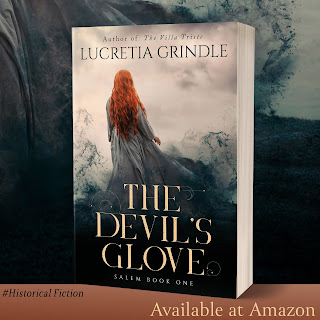
The Devil's Glove by Lucretia Grindle


Northern New England, summer, 1688.
Salem started here.

A suspicious death. A rumor of war. Whispers of witchcraft.

Perched on the brink of disaster, Resolve Hammond and her mother, Deliverance, struggle to survive in their isolated coastal village. They're known as healers taught by the local tribes - and suspected of witchcraft by the local villagers.

Their precarious existence becomes even more chaotic when summoned to tend to a poisoned woman. As they uncover a web of dark secrets, rumors of war engulf the village, forcing the Hammonds to choose between loyalty to their native friends or the increasingly terrified settler community.

As Resolve is plagued by strange dreams, she questions everything she thought she knew - about her family, her closest friend, and even herself. If the truth comes to light, the repercussions will be felt far beyond the confines of this small settlement.

Based on meticulous research and inspired by the true story of the fear and suspicion that led to the Salem Witchcraft Trials, THE DEVIL'S GLOVE is a tale of betrayal, loyalty, and the power of secrets. Will Resolve be able to uncover the truth before the town tears itself apart, or will she become the next victim of the village's dark and mysterious past?


Connect with Lucretia


Lucretia Grindle grew up and went to school and university in England and the United States. After a brief career in journalism, she worked for The United States Equestrian Team organizing ‘kids and ponies,’ and for the Canadian Equestrian Team. For ten years, she produced and owned Three Day Event horses that competed at The World Games, The European Games and the Atlanta Olympics. In 1997, she packed a five mule train across 250 miles of what is now Grasslands National Park on the Saskatchewan/Montana border tracing the history of her mother’s family who descend from both the Sitting Bull Sioux and the first officers of the Canadian Mounties.

Returning to graduate school as a ‘mature student’, Lucretia completed an MA in Biography and Non-Fiction at The University of East Anglia where her work, FIREFLIES, won the Lorna Sage Prize. Specializing in the 19th century Canadian West, the Plains Tribes, and American Indigenous and Women’s History, she is currently finishing her PhD dissertation at The University of Maine.

Lucretia is the author of the psychological thrillers, THE NIGHTSPINNERS, shortlisted for the Steel Dagger Award, and THE FACES of ANGELS, one of BBC FrontRow’s six best books of the year, shortlisted for the Edgar Award. Her historical fiction includes, THE VILLA TRISTE, a novel of the Italian Partisans in World War II, a finalist for the Gold Dagger Award, and THE LOST DAUGHTER, a fictionalized account of the Aldo Moro kidnapping. She has been fortunate enough to be awarded fellowships at The Hedgebrook Foundation, The Hawthornden Foundation, The Hambidge Foundation, The American Academy in Paris, and to be the Writer in Residence at The Wallace Stegner Foundation. A television drama based on her research and journey across Grasslands is currently in development. THE DEVIL’S GLOVE and the concluding books of THE SALEM TRILOGY are drawn from her research at The University of Maine where Lucretia is grateful to have been a fellow at the Canadian American Foundation.

She and her husband, David Lutyens, live in Shropshire.

Connect with her on her websiteFacebookLinkedInInstagramAmazon Author Page, and Goodreads

Visit other tour stops!


Friday, May 5, 2023

Deborah Sampson: A Woman at War


An excerpt from Women of the American Revolution:

A soldier’s life was dangerous. If one was not injured or killed in combat, they still had the unsanitary camp conditions to deal with. High casualties can be attributed to disease, cold, and heat rather than any British weapon. Reasons women might disguise themselves in order to fight were numerous, despite the risks. Those who were enslaved or indentured servants might see it as a path to freedom, especially if they were light complexioned enough to claim Caucasian ancestry once away from those who knew of their origins. Women might attempt to leave behind a shameful past or hide a premarital pregnancy. Like Deborah, they might hope to escape poverty or the insecurity of being a single woman in a nation at war. Some fled abusive husbands or parents, and, just as their male counterparts did, some women wanted to join the war effort due to passionate patriotism. 

Whatever was Deborah’s inspiration, in April 1782 she enlisted in the army, claiming to be Timothy Thayer. Discovered and in fear of prosecution, she fled her native Middleborough, Massachusetts. Whether she had intended to honor her enlistment or whether she, like many others, was hoping to slip away with her signing bounty in hand, is unknown. But when she enlisted a second time on 20 May 1782, this time as Robert Shurtliff, a name common enough in the area to allow Deborah to remain anonymous, she accepted a bounty of £60 and joined new recruits at Worcester for muster.  The American victory at Yorktown had taken place the previous October, but three-year recruits were still being signed on in the case that a treaty did not follow as expected. After all, it was not the first American victory of the war and news took weeks to cross the Atlantic. The Continental Army could not yet rest.

Read more about Deborah and her life after the war in Women of the American Revolution! It is available at Pen & SwordAmazonBook DepositoryBarnes & Noble, or your favorite book retailer. 


Also available now at Audible and audiobooks.com!

You can also find more articles here.

Join me on your preferred social media for daily fun facts, on this day in history posts, and lots of pictures!

Facebook

Instagram

Twitter


Saturday, April 22, 2023

But One Life: An Excerpt


On 22 April 1775, the coastal town of New London, where Nathan Hale was a school teacher, responded to the news of battle at Lexington and Concord. The following is an excerpt from But One Life, based on historical records that note Hale stepping up to speak to the men who had gathered.


A town meeting was called to discuss New London’s response to the battles at Lexington and Concord. The British were besieged in Boston, and some believed we should take the fight directly to them. Would it send them scurrying across the ocean or bring down the awful wrath of the greatest military in the world?

Of course, there were also those who wished to wait for more news or a response from London or whatever that something was that would spur them into action. I had read enough history to know that timidly waiting for the right moment rarely led to victory. Though I was young and not native to New London, I stood.

‘Let us join our brothers in arms in their stand against tyranny. I will go. Who is with me?’

I was surprised how many men loudly roared their agreement once one had stood to boldly speak. I had to yell to be heard over them.

‘Let us march at once and never lay down our arms until independence is won!’

I could scarcely believe myself, but I felt infused with the strength of my friends and loved ones. It was for their liberty and peace that I was willing to fight.


Sunday, April 16, 2023

Peggy Shippen's Lost Gamble


Peggy Shippen Arnold was rarely suspected of playing a role in her husband's treason. She can thank the 18th century mindset that made it practically unthinkable for a woman to do such a thing. Peggy may have even been the mastermind behind Benedict Arnold's attempt to hand West Point over to the British. That plan failed, and British Major John Andre ended up executed, but what about the Arnolds? What happened to them after they ended up on the losing side of the war?

From Women of the American Revolution:

"The British surrendered at Yorktown on 19 October 1781. After betraying their country, the Arnolds found themselves on the losing side. As they packed to leave for London, a city Peggy had never visited, she must have wondered if she would ever see her family again. They sailed on 8 December 1781. The Arnolds were not alone. Thousands of loyalists and African Americans fled the new country that was less than welcoming to them.

Peggy was well received in London. Called the ‘Fair American,’ she found her place in society, and she may have felt a bit like her old Philadelphia days if not entirely vindicated in the decisions she had made. The Arnolds were presented to King George and Queen Charlotte. They were rewarded generously for their service, even if General Arnold had not provided the British with the victorious engagement for which they had hoped. A pension paid to Peggy separate from the money paid to her husband is further evidence of her active involvement with the treachery that had left André dead."

Benedict Arnold tried his hand as several money making schemes, one of them in Canada. In 1786, he brought Peggy and their children to join him in New Brunswick in the hope that they would find success and happiness there.

More from Women of the American Revolution:

"In St John, New Brunswick, Peggy made a comfortable home for her family, bringing furnishings from London and her indominable spirit. Arnold collected his entire family at their new home, including his spinster sister, Hannah, and his older children. It is unknown at what point after her arrival that Peggy learned of another child her husband had sired. One must wonder after all she had suffered at his side how Peggy felt to discover that Arnold had fathered a child with a woman in St John during his first trip to Canada. At just the point when their life seemed to be turning around, Arnold’s affair drove a wedge between he and his wife. Two months after arriving in St John, Peggy gave birth to another son, named George like the son who had died, a common practice at the time. Had Peggy already learned of her husband’s infidelity? One can imagine how much it might change her state of mind as she recovered from childbirth, depending upon when this realization was made."

The business in Canada failed, and, with Peggy and the children returned to England, Arnold decided to try his luck in the Caribbean, but he was never satisfied with his endeavors.

More from Women of the American Revolution:

"It is difficult to guess at Peggy’s feelings when Benedict Arnold died on 14, June 1801. He had been irrational, unsuccessful, and unfaithful, but she had stood by him, mostly uncomplainingly. Being a widow had its own challenges, but Peggy addressed them head on. Peggy’s key concern was her finances. Her husband had created a complicated web of business contracts and debts that Peggy was responsible for unwinding as executor of his estate. The fact that Arnold had named his wife executor is evidence of her intellect and his trust in her, as few eighteenth century wives were selected for this role that was typically reserved for men. Peggy had five children besides Arnold’s older sons and illegitimate son in Canada, who he had not left out of his will. One can only imagine what Peggy thought of her husband of twenty-two years including his 14-year-old bastard in his will while she scrambled to ensure her own children’s futures. She refers to him in letters to her sons simply as ‘the Boy,’ though she knew his name was John Sage. ‘The Boy who is with you ought to be taught, by his own labor, to procure his own livelihood; he ought never to have been brought up with any other ideas.’" 


Read more about Peggy Shippen Arnold and her struggles after the death of Benedict Arnold, as well as several other amazing 18th century ladies, in my newest book, Women of the American Revolution. It is available at Pen & SwordAmazonBook DepositoryBarnes & Noble, or your favorite book retailer. 

Also available now at Audible and audiobooks.com!

You can also find more articles here.

Join me on your preferred social media for daily fun facts, on this day in history posts, and lots of pictures!

Facebook

Instagram

Twitter