Showing posts with label Grace Fryer. Show all posts

Wednesday, March 10, 2021

Battling the Radium Industry


If you have read my novel, Luminous, you know that Catherine Wolfe Donohue's courtroom battle against Radium Dial ended victoriously - sort of. Catherine suffered physically and mentally due to the treatment she received at the hands of her former employer and even some townsfolk who did not want to see a big employer put out of business. Her case caused radium poisoning to be recognized by the Illinois Industrial Commission as an industrial disease for which employers should be held liable. Catherine's case was decided in 1938, long after those who studied radium were aware of its harmful effects. Also after Catherine had died.

Catherine Donohue with
Dr Charles Loffler

Employers in Illinois, Connecticut, and New Jersey utilized a variety of arguments to escape liability for instructing their employees in the use of the deadly substance. At a time when worker compensation laws were not robust and some still believed in a worker beware approach to dangerous jobs, knowing radium was poisonous was not enough. Those suffering from contact with radium had to prove it was the cause AND prove that their employers should be held responsible for it.

The women who worked at US Radium Corp in New Jersey fought for recognition much like the women in Illinois did. Grace Fryer searched for an attorney who would take on her case for two years, and once she found one she convinced other women to join the lawsuit. Their case first went to court in 1928, after several dial painters at US Radium Corp had died. The causes of their deaths, like women in other areas, were attributed to diseases such as diphtheria, tuberculosis, cancer, and, embarrassingly, syphilis. It was Grace and her friends who were first referred to as Radium Girls, a term that is now familiar and used for dial painters across the country. 

Grace Fryer

Grace and the other New Jersey women settled for a cash payout of $10,000 and their medical expenses paid for life, and their case paved the way for other women to stand up for themselves against the radium industry. Unfortunately, US Radium Corp was not done betraying these women. After covering some expenses, they stopped payments claiming that the women no longer suffered from radium poisoning. As the slow wheels of justice turned, US Radium Corp had the advantage that those suing them were dying faster than the courts moved.

Some of the debate over the women's causes of death were reasonable. Due to the way the human body absorbs radium as if it were calcium, the women experienced a wide variety of symptoms. Even for those who believed the cause was radium, it was difficult to state with certainty what one who was suffering from radium poisoning would experience. Those who suffered acute symptoms often lost their teeth, bones became brittle, and joints arthritic. Some women did not suffer as alarming early symptoms but later endured fertility problems and cancers. Anemia, sores, fatigue, weight loss and tumors were often reported.

As understanding of the variety of symptoms of radium poisoning increased, the attitudes of companies employing young women to work with radium infused paint did not change. If radium was dangerous, they were well compensated for the risk they took. Employers were not responsible for employee health, they attempted to argue.

Although few of the women who suffered radium poisoning gained much personally from their court cases, they did bring worldwide awareness to the dangers of radium. This knowledge led to protections for others in the handling of radium and other radioactive substances. Scientists working with plutonium as part of the Manhattan Project in the 1940s took strict precautions, partly due to the cases of the Radium Girls. In 1971, the Occupational Health and Safety Administration was established to ensure that what had happened to these women would not happen again. 

Letter to Pearl from Argonne Laboratory, 1978
Pearl Payne Collection, LaSalle Historic Society

The Argonne National Laboratory studied former dial painters from 1968-1993, compiling comprehensive information on the short and long term impact of exposure to radium. They exhumed the bodies of some who had died, including Catherine Wolfe Donohue's. The women's bodies exuded dangerously high levels of radioactivity decades after they had died and will continue to do so for hundreds of years. Many former dial painter graves will set off a Geiger counter. Catherine's friend, Pearl Payne, went to Argonne for years until she decided that her health was not benefiting from it.

However, radium was still used at Luminous Processes (the business created by owners of Radium Dial to protect assets from lawsuits) until 1978. Ottawa, Illinois, the home of Radium Dial and Luminous Processes continues to struggle with dangerous levels of radiation and elevated cancer rates, but how much worse might it be if a few working class women hadn't stood up for themselves back in the 1930s?

A monument near downtown Ottawa memorializes the dial painters who lived there, and other efforts have been made to honor their legacy. A new movie, Radium Girls, features fictional characters but closely mirrors the experiences of the New Jersey girls, including Grace Fryer. You may even recall a recent project to remember them with a modern glow-in-the-dark watch. I appreciate any efforts to ensure that history is not forgotten, especially the memory of those who sacrificed their own lives that ours might be better. But I think those working class women who believed they were blessed to obtain a well-paying job as a dial painter would be most proud of the protections that they have gained for others, even if their own names are often forgotten.


Wednesday, March 4, 2020

Radium's Death Toll

Pierre and Marie Curie
When discovered by science's power couple, Pierre and Marie Curie, in 1898, radium was considered a magical element. It's characteristics were not replicated elsewhere in nature, and it was believed to have miraculous healing properties.

Radium treatments were used to kill cancer cells and reduce the size of tumors. Potions and infusions were sold to improve digestion or use as a beauty tonic. Radium also had a peculiar glow that led to its use in paint for dials and instruments used in World War I. Instead of a pocket watch, soldiers began wearing wrist watches, which were easily accessed in most circumstances and could be read at night because of the radium mixture used to paint the dials.

Then it started killing people.

It is difficult to shift people's opinion of something from one extreme to the other, especially if those people are profiting from its sale. Such was the case with radium, and countless people died before the radioactive element was treated with appropriate control and safety standards.

Marie Curie, who had exposed herself and her assistants to radium for years, was anemic and suffered from leukemia when she died. Both were most likely caused by radium. Sabin von Sochocky was the inventor of the glowing paint that was used by thousands of young women as part of the war effort. He, too, died of aplastic anemia caused by radium exposure. We will never know how many of those dial painters died of conditions caused by radium poisoning because their complaints were ignored for decades as a wide variety of diseases and cancers resulted from their exposure.

Sabin von Sochocky knew he was taking a risk. He had cut off part of his own finger when it became damaged by radium. Those working in his New Jersey lab wore lead-lined aprons and handled radium with caution. However, the young women working as dial painters for the same company used no protection and pointed brushes dipped in radium paint with their lips in order to accurately trace the tiny numbers.

Grace Fryer
Grace Fryer was shocked when Sabin von Sochocky admonished her not to put the brush in her mouth. That was how all the dial painters did it. Later, when Grace Fryer and others were suing US Radium Corp for damages, he tried to backtrack on this comment, not because he believed radium was harmless but because he didn't want his company to have to pay the medical expenses for the sick and dying employees.

The same thing was happening at Radium Dial in Illinois. Young women were dying, and it was contributed to everything from syphilis to diphtheria. No doctor wanted to be the first to say that radium was poisonous, even if those who had worked closely with it for years already knew that to be the case.

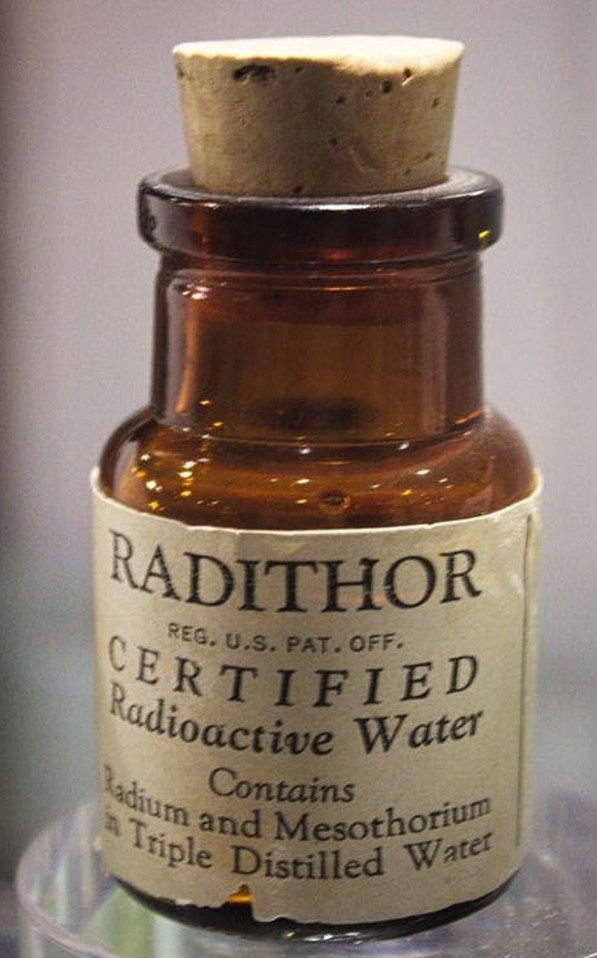
It is unknown how many dial painters, including Grace Fryer, died of radium poisoning because so many were denied justice and some didn't die until decades later of cancers that likely had radium at their source. But few seemed concerned until the death of Eben Byers in 1932, fourteen years after the end of World War I. A rich, well-known socialite, Byers took to the radium trend with gusto, drinking Radithor (radium infused water) by the case. He died painfully, his mouth and jaw rotting away, just as the poor dial painters had been doing for over a decade.

With the death of one more valued by society than dozens of working-class girls, radium products were removed from shelves. Finally, a discussion of radium's hidden dangers began, but the health and environmental impact of radium use continues to this day. In Orange, New Jersey, and Ottawa, Illinois, where dial painting studios once stood, the Environmental Protection Agency is still working to clean up Superfund sites, and both towns suffer high rates of cancers and other health issues in residents and wildlife.

~~~~~~~~~~~~~~~

Additional Reading:
Radium Girls: Women and Industrial Health Reform, 1910-1935 by Claudia Clark