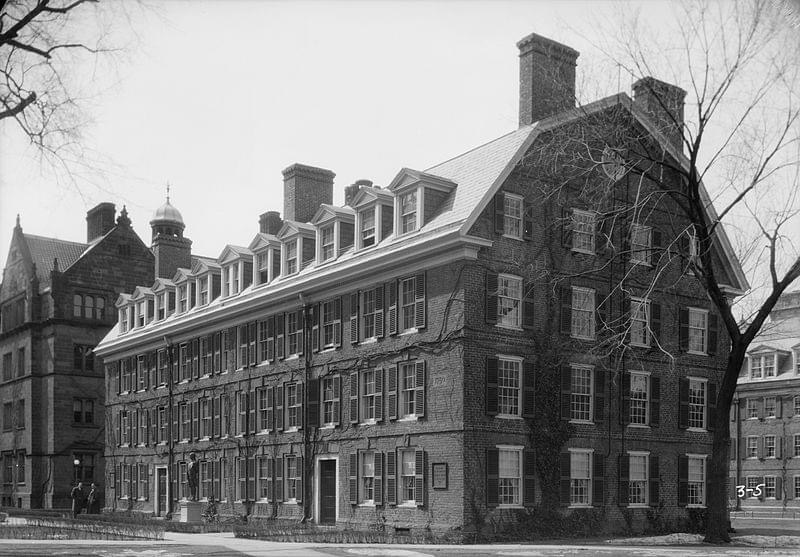
Nathan Hale is remembered today as the quintessential patriot who proclaimed that his only regret was that he had but one life to give for his country. We don’t actually know for sure if Hale said those words, but we do know that he gave his life on 22 September 1776 when he was hanged as a rebel spy. He was only twenty-one years old and had graduated from Yale College three years earlier. He had been at school through the rise of revolution and conflict, undoubtedly discussing with his erudite peers the events that led to the Declaration of Independence and Hale’s ultimate sacrifice.
Two months after turning fourteen, Nathan began his collegiate life at Yale alongside his brother, Enoch, who was nineteen months his senior. The brothers were close friends and roommates, distinguished by their peers as Primus and Secundus. Even the Yale billing records refer to Nathan as ‘Hale 2.’ The brothers seem to have been rarely separated until after their graduation in 1773.
They shared several friends who also played their part in the American Revolution. Of these young men, Benjamin Tallmadge would eventually become the best known, with the possible exception of Nathan himself. Tallmadge became a highly successful officer and spymaster in the Continental Army, but at Yale he was just another student, if a particularly intelligent and overachieving one. In his memoirs, Tallmadge admitted that his preparation for Yale meant that ‘I had not much occasion to study during the first two years of my collegiate life, which I have always thought had a tendency to make me idle.’
One evening in 1771, this idleness led to troublemaking when Tallmadge, the Hale brothers, and some other students broke several windows on campus. One can imagine that Enoch, who was studying to be a minister, must have felt particularly repentant when the bill was sent to their father. Benjamin’s father was also a minister, who might have sent his son a strongly worded reprimand when he was informed of the extra charges.
The boys were not generally troublemakers, however, and a great deal of their free time was spent in intellectual debate as part of the Linonia Society. This fraternity, dedicated to ‘the promotion of friendship and useful knowledge’ gave the young men the opportunity to discuss, debate, and inquire on topics from mathematics and astronomy to religion and philosophy. They undoubtedly had lively talks about the current events of the day and the path to revolution, possibly even discussing Joseph Addison’s Cato from which Nathan’s alleged last words were paraphrased.
In 1771, Nathan served as scribe for the Linonia Society, and his name appears at the end of the surviving meeting minutes. He recorded event participants, questions presented, and topics discussed. One of the items he records is the creation of the society’s library. Since Yale made books available only on-site, the Linonians decided to supply their own library with books that could be checked out by members. The Hale brothers and other members each made contributions of a varied collection of books, including the works of Shakespeare, The Vicar of Wakefield, Rollins Ancient History, Paradise Lost, and The Art of Speaking.
When the Hale brothers graduated in 1773, Nathan participated in a debate on the education of women. The transcript of this debate has not survived, but the fact that Nathan later opened lessons to young women at the school he managed gives us insight to the strength of his feelings on this topic. During his brief time as a schoolmaster before entering the army, Nathan taught girls from 5-7am before his male students arrived for the day.
Through his experience at Yale, we can see the development of Nathan Hale into an intelligent, loyal patriot who was willing to sacrifice all, even his life, for his ideals and for his country.

Read more about the life of Nathan Hale in But One Life, available on Kindle and in paperback. Read it FREE with Kindle Unlimited!