Saturday, February 25, 2023

Agent 355 or Just Some Lady?


An excerpt from Women of the American Revolution:

"Washington had begun intelligence efforts within a fortnight of gaining command of the Continental Army, writing, ‘There is nothing more necessary than good intelligence to frustrate a designing enemy, & nothing that requires greater pains to obtain.’ The Culper Ring was one of the most extensive spy networks of the American Revolution. It was composed of people that Tallmadge knew personally and trusted implicitly. Abraham Woodhull and Caleb Brewster had grown up in Setauket, New York with Tallmadge, and they formed the center of the ring. Initially, Woodhull went by the alias Samuel Culper. Later, Tallmadge assigned him the code number 722. Agent 355 was likely a woman known by Tallmadge or Woodhull in order to have been included in the Culper Spy Ring.

Was she the wife of a friend? Servant? Slave? Maybe she was not connected to Tallmadge and Woodhull at all but was brought into the ring by another agent. Morton Pennypacker, an early Culper Ring historian, first suggested in 1948 that she was the secret wife of Robert Townsend, an agent (designated by 723) living in New York City during the British occupation. This is the theory historian Corey Ford finds most compelling in his 1965 A Peculiar Service, which takes an in depth look at 1770s New York. This romantic possibility has been taken up by historical novelists, and it appeals to readers who love a tragic romance. But is it true?"  

We may never know the truth of Abraham Woodhull's Agent 355, and maybe that's alright. It certainly proves she was a better spy than many others have been! It also leaves a rich field for imagination and much historical fiction including a creative version of this mysterious historical lady.

Returning to Women of the American Revolution:

"Agent 355 may only be a figment of overactive imaginations, and many historians remain unconvinced of her existence beyond being just what Woodhull said, ‘a lady of my acquaintance.’ Female spies were uncommon but not nonexistent in the American Revolution. Some operated on their own, sending information to husbands or brothers in the army, and others were part of more organized networks. In many situations, women found themselves the holders of important information simply because men assumed they were not listening or could not understand the significance of what they were overhearing or observing." 
It wouldn't be the first or last time women have been underestimated, and female spies knew how to use that fact to their advantage! 

If you would like to learn more about Agent 355 and other amazing 18th century ladies, please consider my newest book, Women of the American Revolution. It is available at Pen & SwordAmazonBook DepositoryBarnes & Noble, or your favorite book retailer. Also available now at Audible and audiobooks.com!

You can also find more articles here.

Join me on your preferred social media for daily fun facts, on this day in history posts, and lots of pictures!

Facebook

Instagram

Twitter

Saturday, February 18, 2023

Historic Places: St Helen's Church


Hello, dear readers! You will recognize my guest today, because she has been here before. One of my favorite book series is by the fabulous Toni Mount, and she is here to talk about the newest installment, The Colour of Bone. If you haven't fallen in love with Seb Foxely yet, it's time for you to start this series!

Welcome, Toni!

~ Samantha

~~~~~~~~~~~~~~~~~~~~~~~~~

St Helen's Church, Bishopsgate: Life and Death in Tudor London

Guest Post by Toni Mount

This blog evolved following a research trip to St Helen’s Church in Bishopsgate, checking out details and searching for inspiration for my next Sebastian Foxley Medieval Murder Mystery, The Colour of Bone. St Helen’s and its near neighbour, St Andrew’s Undershaft – ‘undershaft’ refers to the maypole kept at this church in medieval and Tudor times ready for the annual May Day celebrations – having survived the Great Fire of London in 1666 and the Blitz of World War II, were both badly damaged by terrorist bombings twice in the 1990s but remain as the two medieval churches in the city still in use today.

St Helen’s in particular has a wealth of history and is said to be second only to Westminster Abbey in the number of funerary monuments it contains. It is these monuments which have some intriguing stories to tell concerning those who lived – and died – in Bishopsgate in the fifteenth and sixteenth centuries. 

View of St Helen's Church with its gigantic neighbours,
taken from the 'churchyard' [GRM 2022]


Today, St Helen’s is overshadowed by the modern tower-blocks of the Gherkin and the Cheese-grater and isn’t far from the Shard but, even five centuries ago, its nearest neighbour was reckoned the most imposing secular building in London: Crosby Place. St Helen’s churchyard is now paved over and a solitary tomb stands there, that of a jeweller, Robert Dingley, dated to 1741.

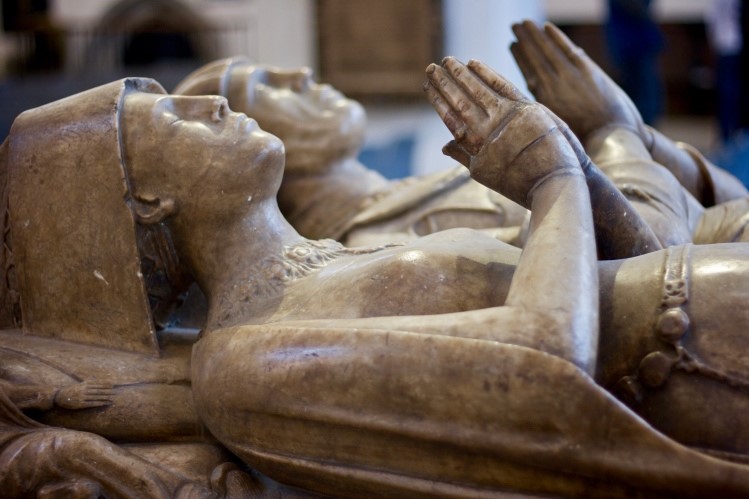
Inside St Helen’s, there is a superb monument tomb of Sir John Crosby and his first wife, Agnes. He is in armour with a Yorkist Suns-and-Roses collar and she wears a fashionable late fifteenth-century headdress with her lap-dogs at her feet. Agnes had predeceased Sir John in 1460 and he designed their joint tomb. 

The tomb of Sir John and Agnes Crosby
in St Helen's Church [GRM 2022]


Sir John also bequeathed 500 marks to St Helen’s Church, money which was used to redesign the interior of the nave. The church had a double nave: the original parish nave and, to the north, a second, parallel nave exclusively for the nuns, constructed in the early thirteen century when William Goldsmith founded the Benedictine convent next door. A row of arches and a screen shielded the nuns from the common folk but Sir John’s bequest was used to build taller, more elegant arches and a new screen in 1480. [This rebuild is the first crime scene in The Colour of Bone.]

Sir John's four new arches viewed from the Nun's Choir [GRM 2022]


In 1538, St Helen’s Priory was surrendered to King Henry VIII, along with all other abbeys, priories and religious houses at the Dissolution of the Monasteries. However, because the church was also the parish church, it was left intact.  

A near-neighbour in Bishopsgate was Sir Thomas Gresham. He was Queen Elizabeth I’s financial whizz and built the Royal Exchange – which he’d intended to name The Gresham Exchange but the queen had other ideas. Even so, Sir Thomas’s badge of the Grasshopper was all over the building and is also on his grand tomb in St Helen’s Church. After his death in 1579, in his will, Sir Thomas left money to set up and pay for Gresham College as a London institute of learning which still exists today as the Gresham Institute.

Sir Thomas Gresham's marble tomb in St Helen's Church [GRM 2022]


Other important citizens and Tudors of note buried in St Helen’s include Sir Andrew Judd who was Lord Mayor in 1550-51 and died in 1558. Sir William Pickering was Queen Elizabeth’s Ambassador to Spain who died in 1574. He also has a splendid marble tomb with his effigy and an elaborate canopy, all protected by wrought iron railings.

Sir William Pickering's effigy lies secure behind railings [GRM 2022]


Another man of interest, although he only has a wall-mounted plaque, is Captain Martin Bond. He lived until 1643, so his monument isn’t Tudor, but in 1588, at the time of the Spanish Armada, he was the commander of London’s Trained Bands – a sort of Elizabethan Home Guard – based at Tilbury in Essex. It seems likely that Bond may have heard Queen Elizabeth making her famous speech to the troops there: ‘I have the heart and stomach of a king, etc’.

Despite the Cavalier fashions, Capt Bond in his tent with the army (1643) [GRM 2022]


Another man of note at St Helen’s is Sir Julius Caesar Adelmare – what a name! He was Master of the Rolls to Queen Elizabeth and lived on to become a Privy Counsellor to King James I, dying in 1636. His wall-mounted monument shows a legal document with the seal broken off in which he has promised to ‘pay the debt of nature’ as soon as God pleases. The debt is, of course, ‘death’, so having died, Sir Julius has fulfilled the agreement and the document becomes obsolete, as shown by the broken seal.

Sir Julius Caesar Adelmare's fulfilled agreement with God [GRM 2022]


Despite all these grand tombs and intriguing monuments, the prize for the tomb that tells the most fascinating story must go to Sir John Spencer and his family. Sir John was another wealthy merchant in the textile trade – so wealthy that they called him Rich Spencer, making his money from trade with Spain, Venice and Turkey. In 1591, he came under suspicion of becoming extraordinary rich … by falsifying and monopolising of all manner of commodities

Being wealthy had its dangers and a story is told later of a plot by a Dunkirk pirate to abduct Spencer and hold him to ransom for £50,000. Leaving his ship with six of his men in Barking Creek, the pirate and the other six crew members made for Islington, intending to seize Spencer on his way to his country house at Canonbury. Luckily for him, the merchant was detained in London on business and the plot came to nothing. How the failed plan became known isn’t revealed but it was recorded in Vanity of the Lives and Passions of Men, published in 1651, long after the event, if it actually happened at all. Queen Elizabeth is said to have visited Spencer at his Canonbury estate in 1581.

In 1583-84, Spencer served as one of the two Sheriffs of London and was required to search out papists in the Holborn area. Among those he arrested were Antonio Bassano and his colleagues, the Queen’s Musicians. He had a lot of explaining to do in this case. Spencer served as Lord Mayor of London in 1594-95. Obviously, his falsifying and monopolising didn’t hold back his political career. At the time, he was living at Crosby Place, although it had needed expensive renovation before it was smart enough to be the Lord Mayor’s official residence. John Stow described Crosby Place in 1598, in his Survey of London as ‘of stone and timber, very large and beautiful and the highest in London’, so Spencer succeeded.

Spencer didn’t have an easy term as mayor. Following years of poor harvests, that of 1594 failed badly and England suffered famine. Spencer managed to persuade the City Companies to send any spare grain in their warehouses to Bridge House, on London Bridge, for distribution to the poor and starving. Hearing of this grain store, Admiral Sir John Hawkins tried to requisition Bridge House and its supplies for the use of the queen’s navy and baking ship’s biscuits for the fleet. Spencer refused and managed to keep the grain to feed the poor. The queen must have approved his actions because she knighted him soon after.

His only child by his wife, Alice Bromfield, [who shares his tomb] was a daughter, Elizabeth, and she has another story to tell. In 1598, William, Lord Compton, proposed marriage to Elizabeth but her father refused to allow the match. Compton used his powerful friends at court and had Spencer arrested and thrown into the Fleet Prison, accused of ill-treating his daughter – we don’t know if he did treat her badly or whether it was a trumped-up charge. Compton then resorted to desperate measures to secure his beloved, having her smuggled out of Canonbury House in a large baker’s basket used for carrying loaves. The couple wed immediately but her father withheld Elizabeth’s dowry, unsurprisingly, and refused to forgive her elopement, even when she gave birth to his first grandchild in 1601. Fortunately, reconciliation was brought about by no lesser person than Queen Elizabeth herself. 

Sir John continued to serve in a civic capacity into the reign of James I, serving as President of St Bartholomew’s Hospital from 1603 until his death ‘at an advanced age’ in March 1610. His wife died just three weeks later and both rest in St Helen’s most colourful tomb. His funeral was sumptuous, his fortune estimated to be between £500,000 and £800,000 – a sum so vast that the inheritance was said to have ‘turned the brain’ of his son-in-law, Lord Compton, temporarily. However, despite such wealth, Spencer bequeathed nothing to the city or people of London. 

The Spencer Tomb [GRM 2022]


His and Lady Alice’s tomb shows the fashionable Elizabethan couple in full colour with their repentant daughter, Elizabeth, kneeling at their feet, wearing a French farthingale. Their monument, severely damaged by the bomb-blasts of the 1990s, was fully restored from photographs, including the paintwork. The whole is topped by a skull and an hourglass as a memento mori. That concludes my tour of the church where the dead of long ago rest in peace. 

[This article first appeared in Tudor Life magazine]
 
In my new novel, St Helen’s isn’t the peaceful haven in the midst of a noisy city that it is today because it’s a building site. Neither are the nuns contemplative quiet souls. All is not as it should be… and you can discover what’s going on in Seb Foxley’s latest medieval murder mystery, The Colour of Bone.


It’s May 1480 in the City of London. 

When workmen discover the body of a nun in a newly-opened tomb, Seb Foxley, a talented artist and bookseller is persuaded to assist in solving the mystery of her death when a member of the Duke of Gloucester’s household meets an untimely end. Evil is again abroad the crowded, grimy streets of medieval London and even in the grandest of royal mansions.

Some wicked rogue is setting fires in the city and no house is safe from the hungry flames. Will Seb and his loved ones come to grief when a man returns from the dead and Seb has to appear before the Lord Mayor?

Join our hero as he feasts with royalty yet struggles to save his own business and attempts to unravel this latest series of medieval mysteries. 

Get your copy of The Colour of Bone on Amazon US or UK!
Or start the Seb Foxely series at the beginning with
The Colour of Poison on Amazon US or UK.


Toni Mount is a best-selling author of medieval non-fiction books. She is the creator of the Sebastian Foxley series of medieval murder mysteries and her work focuses on the ordinary lives of fascinating characters from history. She has a first class honours degree from the Open University and a Master degree by research from the University of Kent however her first career was as a scientist which brings an added dimension to her writing. Her detailed knowledge of the medieval period helps her create believable characters and realistic settings based on years of detailed study. 

Connect with Toni at ToniMount.com.

Saturday, February 4, 2023

James Hamilton and the 1835 Great Fire of New York


I've been enjoying reading James Hamilton's Reminiscences and recently discovered that he helped fight the 1835 Great Fire of New York!

'I was awakened between eleven and twelve at night, and told a great fire was raging in the lower part of the city; that the Merchants' Exchange was in danger, where was the statue of my father by Ball Hughes; and that I might, but going there, be useful in saving that work. I was at the same time told that nothing could be done to arrest the fire for want of water; the engines, their leaders and the hydrants being all frozen. I immediately said, powder must be used, and went to the fire.'

Alexander Hamilton
by Robert Ball Hughes
(plaster reproduction)

James goes on to describe setting fire to powder to demolish buildings and create a firebreak & stopping one man from killing them both as he held a candle in a room where the air swirled with gunpowder dust. In the early morning hours, James is able to return to his family. 


'My work was done. My cloak was stiff with frozen water. I was so worn down by the excitement that when I got to my parlor I fainted.'

The statue of Alexander Hamilton in the Merchants' Exchange building was not saved, and though I could find several articles mourning this loss, I found none that mention his son's efforts that night. For in-depth information on the 1835 Great Fire of New York, including mentions of James Hamilton, I recommend, Manhattan Phoenix by Daniel S Levy.

James Alexander Hamilton


Read my short story about James A Hamilton in Masterworks!


Coming in 2024! James Alexander Hamilton: Son of the American Revolution

Tuesday, January 31, 2023

Rich Man's War, Poor Man's Eviction Fight


Good morning, dear readers! I'm pleased to introduce Glen Craney as my guest today. A prolific writer of historical fiction, Glen is here to share some insight into the fate of American soldiers facing the Great Depression following their service in World War I and his book, The Yanks are Starving: A Novel of the Bonus Army

Welcome, Glen!

~ Samantha

~~~~~~~~~~~~~~~~~~~~~~~~~

Rich Man's War, Poor Man's Eviction Fight

Guest Post by Glen Craney


An unlikely American duo made history together twice.

In France, and fourteen years later on the tear-gassed streets of Washington, D.C.


In the Great War, courage had many fathers.

Joe Angelo, a second-generation Italian-American, volunteered as a private for the American Expeditionary Force in 1917 to prove his loyalty to his family’s new country. In contrast, his future captain, George Patton, a brash West Pointer who would become the controversial World War II tank commander, sailed for France eager to match his Confederate ancestors in glory.

Angelo and Patton could not have been more different in background, temperament, or motives for fighting. Yet they came together twice during the early twentieth century to play pivotal roles in U.S. history.

Angelo was as diminutive as Patton was imposing. A laborer in the dangerous DuPont Powder Works in New Jersey, Angelo enlisted at a time when many Italian immigrants still had family in the old country, where support wavered during the first year of the war between the Central Powers and the Allies. First and second-generation Italian-Americans like Angelo came under suspicion in the States, as did German-Americans, some of whom suffered harassment and even lynchings.

Joe Angelo

Patton, despite his aristocratic Virginia roots, saw potential in Angelo and chose him for his orderly. That decision would prove one of the most important in Patton’s eventful life. On a foggy day in September of 1918, he and Angelo stumbled into a desperate machine-gun fight in the Meuse-Argonne. When Patton took a shot to his upper leg, Angelo stayed at his side while the battle raged and managed to drag him to safety. Angelo’s heroism earned him the Distinguished Service Cross.

After the war, Patton climbed the ranks to command the Third U.S. Cavalry, while his orderly returned to the tough streets of Camden. Despite his medal commendation, Angelo would likely have been forgotten to obscurity had it not been for one of America’s most shameful episodes fourteen years later.


George Patton

During the summer of 1932, a charismatic, rail-riding hobo named Walter Waters led nearly 43,000 unemployed WWI veterans and their families into Washington, D.C. to demand advance payment of their deferred service annuity, popularly known as the Bonus. Angelo, nearly destitute, walked 150 miles to testify at a congressional hearing about his plight. He became one of the colorful champions of the Bonus Expeditionary Force, the name adopted by the army of veterans that camped under the shadows of the U.S. Capitol and paced along its steps in a pitiful procession called the Death March.

Months passed in the standoff. Then, at the end of a tense July, General Douglas MacArthur, the Army’s Chief of Staff, called out the infantry regulars from their barracks and drove the encamped veterans and their families from the city with tanks and gas. Patton led MacArthur’s cavalry in the attack down Pennsylvania Avenue. Amid the screams and smoke of the rout, Angelo sought out his former captain whose life he had saved in France.

What happened during their encounter would shock the nation and help decide the U.S. presidential election of 1932.

The Yanks Are Starving: A Novel of the Bonus Army relives the experiences of eight Americans who survived the fighting in France and came together again during the Great Depression to decide the fate of the nation on the brink of upheaval. It is the little-known story of the political intrigue and government betrayal that culminated in the only pitched battle ever fought between two American armies under the same flag.

Two armies. One flag. No honor.

The most shocking day in American history.

Former political journalist Glen Craney brings to life the little-known story of the Bonus March of 1932, which culminates in a bloody clash between homeless World War I veterans and U.S. Army regulars on the streets of Washington, D.C.

Mired in the Great Depression and on the brink of revolution, the nation holds its collective breath as a rail-riding hobo named Walter Waters leads 40,000 destitute men and their families to the steps of the U.S. Capitol on a desperate quest for economic justice.

This timely epic evokes the historical novels of Jeff Sharra as it sweeps across three decades following eight Americans who survive the fighting in France and come together fourteen years later to determine the fate of a country threatened by communism and fascism.

From the Boxer Rebellion in China to the Plain of West Point, from the persecution of conscientious objectors to the horrors of the Marne, from the Hoovervilles of the heartland to the pitiful Anacostia encampment, here is an unforgettable portrayal of the political intrigue and government betrayal that ignited the only violent conflict between two American armies.

Get your copy of The Yanks Are Starving: A Novel of the Bonus Army


Connect with Glen Craney

Glen Craney is an author, screenwriter, journalist, and lawyer. A graduate of Indiana University Law School and Columbia University Graduate School of Journalism, he is the recipient of the Nicholl Fellowship Prize from the Academy of Motion Pictures and the Chaucer and Laramie First-Place Awards for historical fiction. He is also a four-time indieBRAG Medallion winner, a Military Writers Society of America Gold Medalist, a four-time Foreword Magazine Book-of-the-Year Award Finalist, and an Historical Novel Society Reviews Editor's Choice honoree. He lives in Malibu and has served as the president of the Southern California Chapter of the HNS.

Connect with Glen on his Website, Twitter, Facebook, Book Bub, Amazon Author Page, and Goodreads


Saturday, January 21, 2023

Historic Places: Mount Vernon


I recently made my fifth visit to Mount Vernon, the beloved home of George and Martha Washington. Each visit has included its own special element - a trip with my oldest son, one with my daughter, mint juleps just like George Washington used to drink, and the time I got to introduce my husband to one of my favorite places in the country. This time, I got to bring my book that includes my own little chapter about Martha Washington and her life spent mostly in this beautiful place. We also took an in-depth tour and got to see parts of the home that I hadn't seen before.

I'm excited to share it with you!

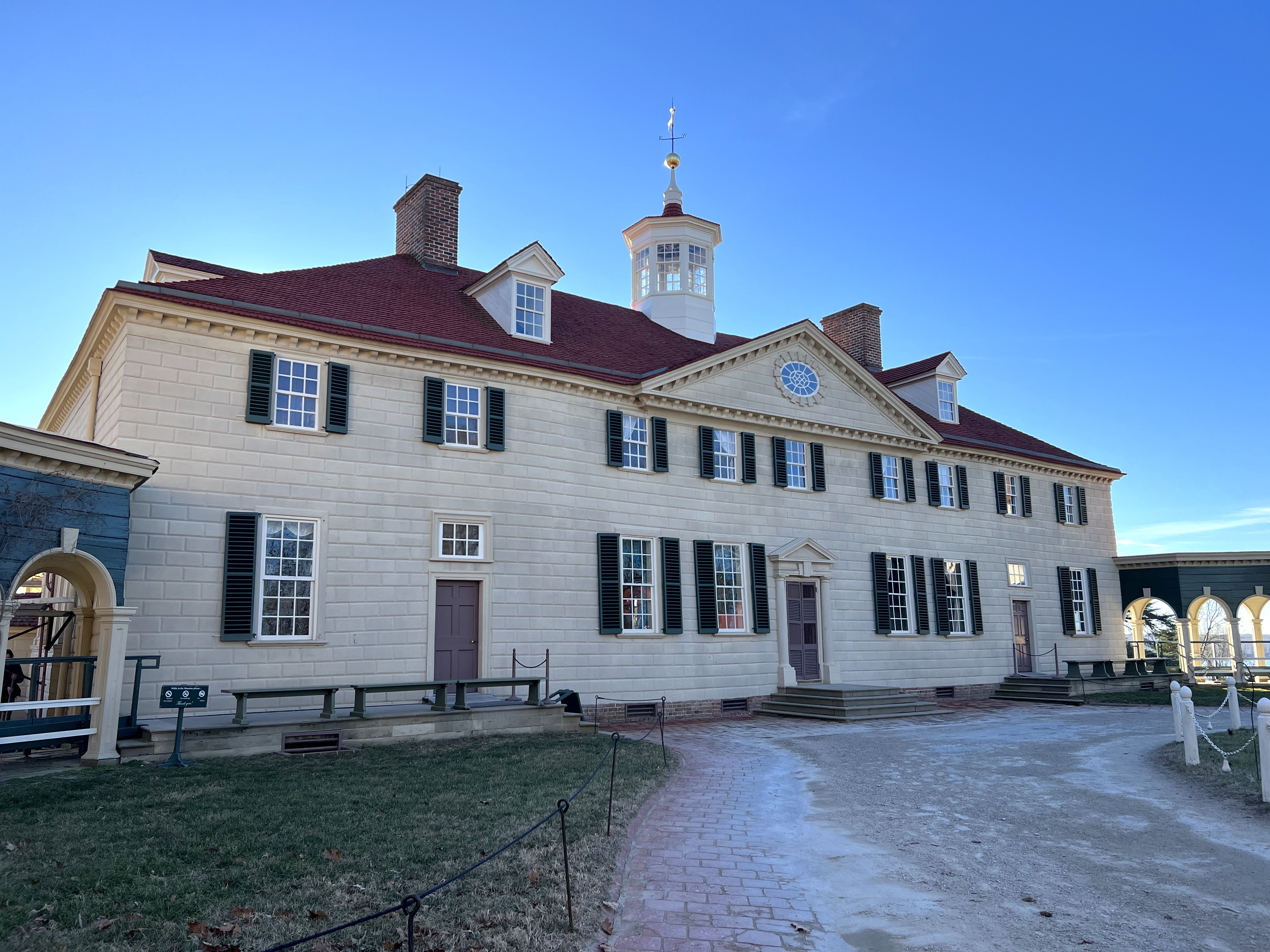
Scaffolding is often seen against one of the walls of Mount Vernon. This time, it was all along the portico facing the Potomac River, so the facade of the mansion was pristine.


The exterior of the home is sided in wood planks that are painstakingly prepared to give the illusion of stone. A special paint blended with sand is used to create this effect, just as it was in the 18th century. The estate has been restored by the Mount Vernon Ladies' Association to appear as it did in 1799, the final year of George Washington's life, but this is not how it appeared when he first inherited it. For a great overview of the evolution of Mount Vernon and George Washington's passion for improving the home and grounds, visit Mount Vernon's website which makes a vast amount of information available to the public

Inside, there is far too much for me to include in a single post, but the room the Washingtons were most proud of was the New Room that they built for entertaining in European style (they hoped, neither of the Washingtons ever traveled to Europe).


This room has a ceiling twice as high as any others in the home and was larger than the entire home of most other Virginians of Washington's time. Hints of George's love of farming and his belief in America's future as an agricultural nation are found all around, including this marble mantlepiece that was designed by him.


Other rooms that may be of particular interest to my readers include the Lafayette Room, where the Marquis de Lafeyette stayed while visiting the Washingtons. The portrait of the Marquis is a reproduction of one that George had commissioned to honor his friend.


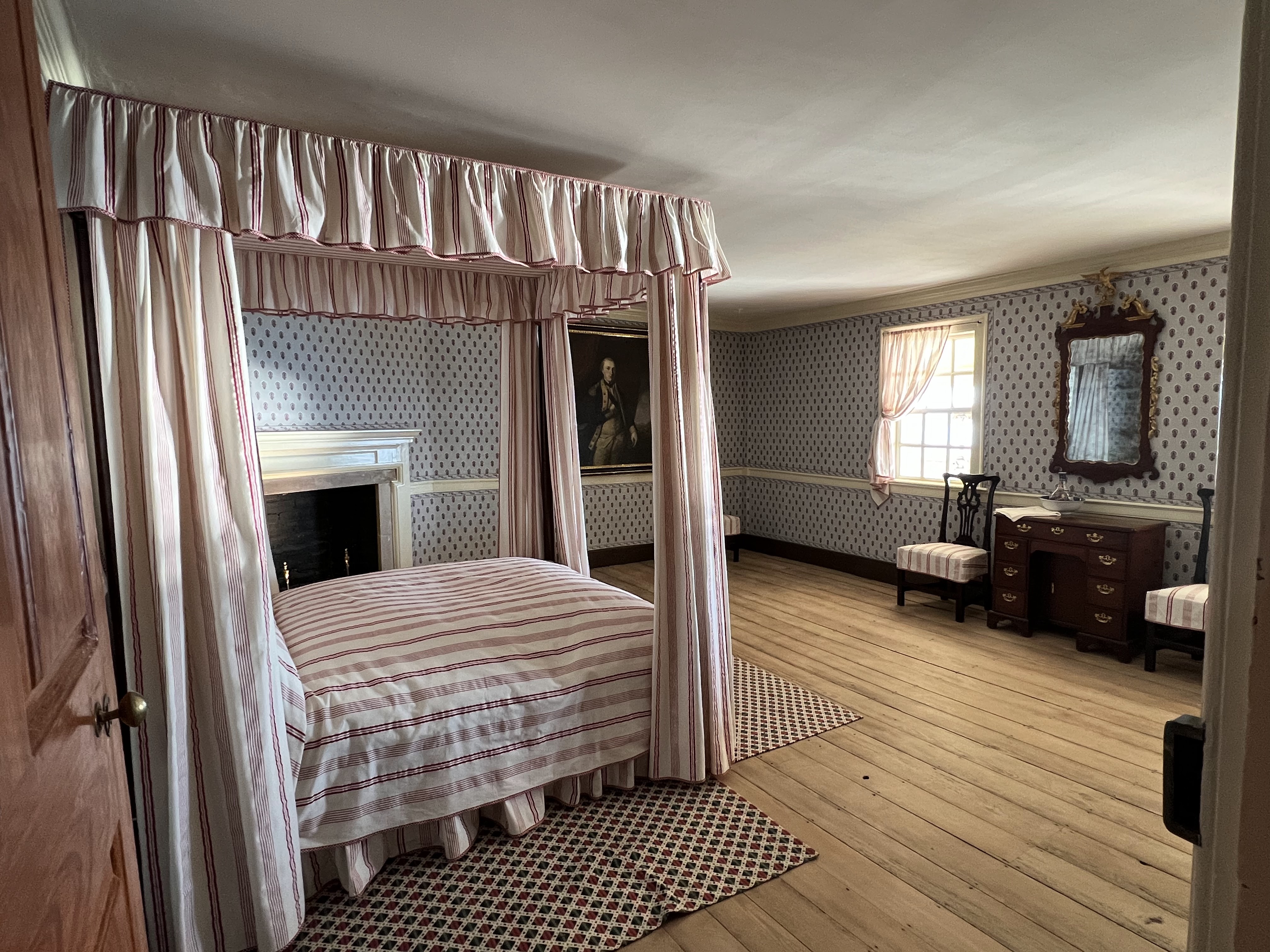
Another room that I mention in Women of the American Revolution is the third floor guest room where Martha moved to after George's death. She never again slept in the bed they had shared.


The Mount Vernon Ladies' Association has performed an astonishing amount of research to determine which guest bedroom Martha used, what paper was on the walls, and all sorts of other facts that we take for granted when we visit Mount Vernon today. The estate was in ruins when they purchased it in 1859. 

I've discovered a fun fact connecting this to my current project on James Hamilton!


Mary Morris Hamilton, James's daughter, was the MVLA's first vice-regent for New York, and she raised about $40,000 of the estate's $200,000 purchase price. I can't wait to include more about her story in my next book! Needless to say, I have a greater appreciation for what these women went through than ever before.

I will share one more fun picture for those who are fans of the National Treasure movies.


You may recognize this cornerstone as the entrance to a secret passage. (We were assured that it is not.) It is a cornerstone believed to have first been used by George's grandfather, Lawrence Washington, to establish the family in Virginia. Mount Vernon researchers believe the cornerstone was preserved and moved until it was eventually installed in the Mount Vernon cellars when George Washington had them built. The one currently in place is actually a replica, but the original is in the on-site museum, which you absolutely must visit if you ever take a trip to Mount Vernon.

I have so many photos and will be sharing more on Instagram


If you would like to learn more about Martha Washington and other amazing 18th century ladies, please consider my newest book, Women of the American Revolution. It is available at Pen & Sword, Amazon, Book Depository, Barnes & Noble, or your favorite book retailer. I appreciate your interest and support!

Available now at Audible and audiobooks.com!

I also have a few other articles written about Martha here.

Join me on your preferred social media for daily fun facts, on this day in history posts, and lots of pictures!

Facebook

Instagram

Twitter