Showing posts with label book review. Show all posts

Friday, November 1, 2024

The King's Intelligencer


I recently jumped at the chance to read an early copy of Elizabeth St John's new novel, The King's Intelligencer, and I am excited to share it with you today. First, I should say that I LOVED The Godmother's Secret, which is kind of a prequel to this novel, though they are not technically published as a series. Besides being jealous of St John's familial connection to these historic events, I share her feelings that there are buried truths that may never be discovered about the famous Princes in the Tower.

This author does a fantastic job of taking women at the edge of well-known history and portraying them as unique, realistic protagonists. (Did I mention they are her own ancestors? Yes, I know I did, but it's fantastic.) In The Godmother's Secret, Elysabeth St John (THEY HAVE THE SAME NAME!) is godmother to Prince Edward, better remembered as the eldest of the missing princes. I won't give away what happens, but it is well-written and historically plausible. Go read it.

The King's Intelligencer picks up almost two centuries later, during the reign of King Charles II, when a set of children's bones are discovered at the Tower of London. Right where Thomas More claimed the Princes in the Tower were buried.
Westminster Abbey Memorial

I have to be honest, I had never actually considered what it was like when those bones were found. St John does a fantastic job of demonstrating that there must have been questions. Lots of questions. Did people of the 17th century accept as fact that Richard III had killed his nephews? Did they think about those little princes at all? Did they wonder who had killed them or if they had actually been killed? Since we still discuss these questions today, I'm going to venture to guess that people of that time did as well, and St John transports the reader right into the middle of it.

The era is vividly recreated with scenes of debauchery at court, Princess Mary's emotional melodrama, the scheming over who would marry the "heir to the heir," and a search for the truth about the bones found in the Tower. Franny Apsley is a descendant of Elysabeth St John, and she is thrown into investigating what really happened and what her family's role in it was.

I don't want to give anything away, but if you can't help but get caught up in debates about the Princes in the Tower, you will enjoy this look at the mystery from the 17th century perspective.

I enjoyed Franny as a main character because she had depth and flaws. She is both independent and afraid to lose royal favor. She finds herself in love but is also intellectual enough to separate lust from other motives at play. Her relationship with Mary is . . . weird, but the author has made it historically authentic. I've really not read about this era, so I enjoyed learning about it.

This book is a slow burn, with real life getting in the way of Franny's objectives, giving the story another dash of authenticity and the reader deeper understanding of 17th century life. Fictional elements of the story are expertly blended with documented history, and the author helpfully explains which is which in her author's note.  (Another side note: the author's other books, The Lydiard Chronicles cover the same family through the English Civil War, so you'll want to pick those up as well if you love a great family saga.)

A highly recommended read for those who love 17th century fiction or those who typically read about the Wars of the Roses.

More about The King's Intelligencer

London, 1674
: When children’s bones are unexpectedly unearthed in the Tower of London, England’s most haunting mystery—the fate of the missing princes—is reignited. 

Franny Apsley, trusted confidante to Charles II’s beloved niece and heir, Lady Mary Stuart, is caught up in the court’s excitement surrounding the find. Yet, as a dark family secret comes to light, Franny realises the truth behind the missing princes is far more complex—and dangerous—than anyone suspects. Recruited by her formidable cousin Nan Wilmot, Dowager Countess of Rochester, to discover the truth behind the bones, Franny is thrust into the shadowy world of intelligencers. But her quest is complicated by an attraction to the charismatic court artist Nicholas Jameson, a recent arrival from Paris who harbours secrets of his own.

Pursued by Nicholas, Franny searches for evidence hidden in secret family letters and paintings, and uncovers a startling diplomatic plot involving Lady Mary, which causes Franny to question her own judgment, threatens the throne, and sets England on a course for war. With only her courage and the guidance of an enigmatic spy within the royal household, Franny must decide how far she will go to expose the truth—and whether that truth will lead to England’s salvation or her own heartbreak.

In a glittering and debauched society where love is treacherous and loyalty masked, Franny must navigate a world where a woman’s voice is often silenced and confront the ultimate question: What is she willing to risk for the sake of her country, her happiness, and her family’s safety?

A captivating historical novel of conspiracy, passion, and courage, The King’s Intelligencer is one woman's quest for a truth that could change the fate of a nation. A companion to the critically acclaimed best-selling novels The Godmother’s Secret and The Lydiard Chronicles, The King’s Intelligencer weaves together beloved characters and actual events to bring a suspenseful mystery to life.


Connect with Elizabeth St John

Elizabeth St.John’s critically acclaimed historical fiction novels tell the stories of her ancestors: extraordinary women whose intriguing kinship with England's kings and queens brings an intimately unique perspective to Medieval, Tudor, and Stuart times.

Inspired by family archives and residences from Lydiard Park to the Tower of London, Elizabeth spends much of her time exploring ancestral portraits, diaries, and lost gardens. And encountering the occasional ghost. But that’s another story.

Living between California, England, and the past, Elizabeth is the International Ambassador for The Friends of Lydiard Park, an English charity dedicated to conserving and enhancing this beautiful centuries-old country house and park. As a curator for The Lydiard Archives, she is constantly looking for an undiscovered treasure to inspire her next novel.

Elizabeth's works include The Lydiard Chronicles, a trilogy set in 17th-century England during the Civil War, and The Godmother's Secret, which unravels the medieval mystery of the missing princes in the Tower of London. Her latest release, The King’s Intelligencer, follows Franny Apsley's perilous quest to uncover the truth behind the sudden discovery of the princes' bones. In Charles II's court of intrigue and deceit, Franny must decide what she’ll risk—for England’s salvation, her family's safety, and her own happiness.


Saturday, April 6, 2024

What I'm Reading: The Great Abolitionist


The Great Abolitionist is one of the most captivating nonfiction books I have read. While researching James Alexander Hamilton, I came across Charles Sumner, even a few letters exchanged between the two men, so I had already included a few bits about him in my own book. Now, I feel like I need to go back and add more. Charles Sumner's courage and absolute certainty in his stance for equality is astounding for his time and in the face of the persecution he endured. I'm not sure how many times I said, "Wow," as I was reading this. It's not just a great biography of Charles Sumner but a thought provoking study of an era when seismic shifts in mindset had to occur for black Americans to begin to experience equality.

I knew about Sumner's Bleeding Kansas speech and the horrific attack that put the South's admiration for violence on public display, but I found that there is much more about Charles Sumner that I didn't know. Puleo's powerful prologue shows us Sumner at Lincoln's deathbed. By this time, Sumner had long experienced and expected violence directed toward himself, but he was still shocked by that against the president. "The Confederate states and 'belligerent slavery' . . . had been 'defeated in battle' and thus had resorted to the most dishonorable, degrading, and cowardly act - assassination."

Then the author takes us back to the beginning of Sumner's fight, decades before anyone knew Abraham Lincoln's name. I found it interesting that "In Sumner's view, the fact that the Constitution did not even contain the word 'slavery' proved that the Founders refused to let it 'pollute its text.'" Hamilton brothers, James and John, wrote along similar lines, and I had not realized that they were inspired by Sumner.  Modern readers may not understand the significance of this. For those who were strong believers in the Constitution, like James A Hamilton, they had long accepted that the federal government had no power to impede slavery within states. Reconsidering the Constitution's stance (or lack thereof) on slavery was radical and necessary.

My favorite part of this book was learning about Charles Sumner fighting against school segregation a century before integration was finally accomplished. How exciting to learn that he was demanding equality before the law so very far ahead of its time! Sumner was not afraid to shame his peers, arguing that "school segregation was Boston's own 'peculiar institution,' in the same way that slavery was the South's." If only the judge in this case had shared Sumner's courage, this decision upholding segregation might not have been used as a legal precedent for 100 years.

Puleo traces Sumner's journey from the Whig party to the Free Soilers and finally as a member of the new Republican party. It seems astonishing in our time to see such political transitions. Perhaps we should take a lesson from our ancestors and follow our values more staunchly than our red or blue team. These shifts were necessary to bring together people with the power to finally stand up against slavery and the Southern politicians who had been controlling the country since its founding.

Sumner's own suffering encouraged people to rethink their political loyalties. When he was violently attacked and almost killed - at his desk in front of other congressmen - people of the north were horrified. They were further disgusted by the celebrations in the south and the many who stated Sumner deserved the beating for his strong words against slavery and those who practiced it. Those who had been on the fence started picking sides. "We went to bed one night, old fashioned, conservative, compromise Union Whigs, and waked up stark mad Abolitionists!"

I could go on and on about this book. We haven't even talked about the Civil War and Sumner's striving to include suffrage, equality, and integration with emancipation. He continued to fight for laws that wouldn't become reality until the 20th century. His perseverance and unshakable belief in what he was fighting for is an inspiration. That being said, the author doesn't shy away from sharing Sumner's weaknesses - his social awkwardness, uncompromising attitude, and failed marriage. The result is a realistic and inspiring portrait of a man we could all learn a lot from. I encourage everyone to read this book.

See more of what I'm reading on Goodreads or what I have reviewed here. I love to talk about books! Let me know what you're reading too. 

Wednesday, March 20, 2024

What I'm Reading: Anywhere But Schuylkill


Some of my readers will appreciate the difficulty of my search for 19th century historical fiction set in the United States. Those who share my desire to read about this era have probably found loads of Civil War fiction and not much else. Because of this, I was excited to have the opportunity to read Anywhere But Schuylkill by Michael Dunn for this Coffee Pot Book Club tour!

Here's the blurb:

In 1877, twenty Irish coal miners hanged for a terrorist conspiracy that never occurred. Anywhere But Schuylkill is the story of one who escaped, Mike Doyle, a teenager trying to keep his family alive during the worst depression the nation has ever faced. Banks and railroads are going under. Children are dying of hunger. The Reading Railroad has slashed wages and hired Pinkerton spies to infiltrate the miners’ union. And there is a sectarian war between rival gangs. But none of this compares with the threat at home.

My Review:

I read this novel with a little bit of previous knowledge of the hardships of coal mining in Schuylkill County, Pennsylvania, but not of this specific event. (For another fantastic series set in coal mining country, see the Ava & Claire series by Karen Heenan.) It can be a challenge to keep track of all the players in this drama, but it is worth it to gain greater appreciation for the impossible situations faced by the men and boys working in the mines and their families.

Mike Doyle was forced to grow up quickly, as were most of the children living in the mining towns of the late 19th century. This was the part of the book that touched me the most. Mike and his younger brother, Bill, wanting to "be men" and support their family, when their ages barely hit double digits.

"He staggered under the weight, which seemed a hundred times more than just Bill, as though he was carrying a house that was crumbling apart, trying to keep his family from tumbling out."

And that's exactly what is expected of them, especially after their father is killed in a mining accident. I probably don't want to know the average life expectancy of a coal miner. I cringed more than once at the conditions they worked under as expertly described by this author.

"As they descended, sparkling black walls slid past them, spiked with rusty nails and burnt shards, a nightmare sky spinning out of control."

Mike was confused by different groups and loyalties and who was actually concerned about his life and interests, and who could blame him? The kid was making adult decisions with little education or assistance, so, of course, he made some mistakes.

"But how could he say no to these guys? They'd just killed two men. He couldn't risk angering them. Couldn't risk becoming one of them either."

The Long Strike of 1875 ends in the tragedy of the execution of twenty men, supposedly for terrorism, but really for daring to stand up for themselves and demand living wages. Mike Doyle escapes this fate but loses almost everything except his life. Where will he go next? Anywhere but Schuylkill.

Connect with Michael Dunn


Michael Dunn writes Working-Class Fiction from the Not So Gilded Age. Anywhere But Schuylkill is the first in his Great Upheaval trilogy. A lifelong union activist, he has always been drawn to stories of the past, particularly those of regular working people, struggling to make a better life for themselves and their families. 

Stories most people do not know, or have forgotten, because history is written by the victors, the robber barons and plutocrats, not the workers and immigrants. Yet their stories are among the most compelling in America. They resonate today because they are the stories of our own ancestors, because their passions and desires, struggles and tragedies, were so similar to our own. 

When Michael Dunn is not writing historical fiction, he teaches high school, and writes about labor history and culture.

Connect with him on his website, Twitter, Facebook, Instagram, Amazon Author Page, and Goodreads.


I am also celebrating Women's History Month! Check out all my wonderful guests and articles about historical ladies!


Join me on your preferred social media to make sure you don't miss a thing!

Facebook

Instagram

Twitter


Sunday, February 11, 2024

What I'm Reading: Black History Month


As I was trying to decide which of my recent reads to spotlight for Black History Month, I said, "Why pick just one?" So here are three titles I've finished this month that look at black life in the early 19th century.

I feel like I need to talk about Incidents in the Life of a Slave Girl first, because it is a first-hand account that is mentioned in both other works. The memoir of Harriet Jacobs exposes the struggles of the enslaved, even those who may not have seemed at first glance to be in a harsh situation. She did not work in fields, was not beaten, and had much of her family around her. However, she was also pursued by her enslaver and manipulated to the extent that, at fifteen, she selected another white man to become her lover and serve as something of a protector. She goes on to tell how she hid in a sparse attic space for YEARS in order to avoid the man who owned her and his amorous advances. It is unfathomable. I think of the discomforts I complain about - the middle seat on an airplane and other minor inconveniences - and I struggle to comprehend what Jacobs endured before finally securing her freedom.

It is much easier to understand why the other two authors mention Harriet Jacobs in their books. Her testimony is powerful and sweeps away some of the comforting lies about slavery told in both the north and the south.

(I listened to Incidents in the Life of a Slave Girl free with Audible Plus.)

One of the most important people in Harriet's life was her grandmother, who was a free woman but was helpless to help Harriet escape beyond hiding her in the attic. In Black Elders, Frederick Knight uses this example and many others to emphasize the value of aged black people in their forced labor communities. Another example is Frederick Douglass, whose grandmother served as substitute for the mother who had been sold away when he was a child. The author provides an astonishing number of individual examples of black elders from the American Revolution through the Civil War and their impact on family, the work force, the church, and politics. While it sometimes feels a little disjointed and repetitive, the sheer number of personal quotes and stories the author has compiled is an impressive accomplishment.

I had hoped for a more in-depth look at the black family in this book and how the situations they were placed in caused the creation of non-biological family units. There are some individual examples of this taking place, but not the broader look at how it impacted (and still impacts) black culture that I was looking for. The author does include many examples of hardship and injustice endured by black elders and their perseverance to serve as honored members of their communities.

One thing that will stay with me from this book was the author's habit of calling plantations forced labor camps. While this is accurate, it is not a term I had applied in this situation. It was a powerful way to strip away any romanticism of the southern plantation lifestyle. This and some of the little-known people Knight mentions were thought provoking and effective in helping readers consider our history from a point-of-view perhaps not previously considered.

(I received my copy of Black Elders: The Meaning of Age in American Slavery and Freedom free through the publisher and NetGalley. Opinions are my own.)

Bound for Canaan: The Underground Railroad and the War for the Soul of America was my favorite of these books, partly because it was most useful for a writing project I am considering. I started out with a library copy and ended up purchasing my own so that I could mark it up and use it for future reference. If you are interested in the Underground Railroad beyond the vague mention that it received in high school history, pick up this book. I was constantly amazed by the testimonies and statistics compiled. It's one of those books that make you realize just how much you don't know.

Some of these facts seemed obvious after reading them, such as the fact that 80% of freedom seekers to the north came from border states. The enslaved in the deep south had little hope and were unlikely to possess any knowledge of where to go if they could escape and travel the many miles to a free state. It's sad and awful and I had never thought about it, but it also makes sense. It added a dimension to the terrible fear of being sold to the deep south.

There's a lot of information here and a lot of people to keep track of, which seems to frustrate some readers, but this book is worth the effort. It tells the story of the Underground Railroad in a comprehensive way, going into great detail about freedom seekers and those who helped them where such historical information is available while stripping away any romantic ideas readers may have of how easy or common escape really was. It was humbling to read about so many people - men and women, black and white - who sacrificed so much to stand up to the horrific slaveholding power. The testimonies are stirring enough to make one wonder, "Would I have the courage to do the same?" I see this book becoming a much-used resource in my research library.

I have a few more books related to the Underground Railroad and America's Civil War on my TBR, so let me know if those are something you'd like to see featured more here. What are you reading for Black History Month?

See more of what I'm reading on Goodreads or what I have reviewed here. I love to talk about books! Let me know what you're reading too. 

Thursday, January 25, 2024

What I'm Reading: Red Clay, Running Waters


Red Clay, Running Waters is a debut novel from author Leslie K Simmons, featuring the true story of Cherokee advocate John Ridge. I am connected with Leslie through Historical Writers Forum and had a peek at the first chapters of this moving novel before its publication. When I was offered the opportunity to read the entire finished product, of course, I said yes. My dear readers will undoubtedly recognize why I was drawn to this tragic protagonist.

From the opening scene, there is a heartbreaking quality about this book. The reader does not need to have deep knowledge of US history to know that Ridge's quest to help lead an independent Cherokee nation within Georgia, or at least have his people maintain some level of autonomy, is doomed from the start. Joining him on his journey is an emotive ride. 

John becomes aware of what the Cherokee people are up against when he travels as a teenager to missionary school in Connecticut. Accepting that Christianity is the price he must pay for an excellent education, he leaves home with lofty goals. Seeing cities like Philadelphia and New York forces him to accept that there will be no holding back the wave of white settlers spreading westward from the east coast. The Cherokee Nation must survive through diplomacy, for it will not be able to do so through power.

John Ridge

An unanticipated result of John's time in New England is his marriage to Sarah Northrop, the daughter of the white family working at the school. The couple underestimates the negativity the revelation of their relationship is met with. John slowly realizes that the white Christians believe the Indians deserve the gospel but not equality. “The respect I believed we gained through our efforts are merely platitudes, a means for the Whites to congratulate themselves on their condescension and benevolence.”

One aspect of the Cherokee's story will likely surprise readers. While most will have some idea of what the Trail of Tears was, less is known about the Cherokee Nation before removal. John and Sarah Ridge lived in an expansive plantation home and enslaved many people. Slave ownership is not excused in this story, though the Ridges are portrayed as benevolent owners, as much as one can be who claims others as property. A few mentions of those who are cruel are made but only as exceptions. There are a few moments of John contemplating the similarity of the Cherokee position to that of blacks, but never to the extent that he considers that blacks too deserve their freedom. It adds a real-life complication to the story to have those suffering from racism practicing it themselves.

At almost 700 pages, this book is a commitment to following Ridge through each step of his struggles. The author does not leave anything out or cram multiple events into one as has become common in modern historical fiction, creating a highly accurate rendition of events but one that moves thoughtfully if sometimes slowly.

The true character of Andrew Jackson is on full display. One character states, “This man of the common people who spurned aristocracy seems to have no issue with treating others like subjects.” I couldn't agree more and have included similar observations in my upcoming biography of James Alexander Hamilton, who served as Jackson's temporary Secretary of State and advised him throughout his presidency. Unfortunately, few people have been as dependent on the outcome as a presidential election as the Cherokee Nation, and Jackson's second term was a disaster for them.

I learned a lot reading this book, and I'm still not sure exactly how I feel about John Ridge. He was devoted to what he felt was right, but was there a way that would have resulted in less heartache? Even in hindsight, I can't say. Neither he nor his family deserved what happened. More than that I will not say, so that you can read his story for yourself in Red Clay, Running Waters.

Read more of my book reviews here or join me on Goodreads!


Saturday, December 9, 2023

What I'm Reading: The Wharton Plot


Last month, I posted the first book review on my blog and decided to make it a habit. This month, I would like to introduce you to The Wharton Plot, a novel by Mariah Fredericks.

My dear readers might know that I adore Edith Wharton. In fact, when tasked with writing a ghost story, the first thing I did was reread my favorites by Wharton, including Afterward. With the goal of creating a story in a similar style, I wrote Among the Lost set in 1927 Northern Michigan.

The Lindburgh Nanny was my introduction to the writing of Mariah Fredericks, and you can read what I thought about it here. Clearly, I enjoyed it enough to jump at the chance to read an early copy of her newest novel. When I received an email from Minotaur Books asking if I’d like to read The Wharton Plot, I said, “Solving a mystery with Edith Wharton? Yes, please!”

Historical facts not treated as spoilers.

Edith Wharton

Since dear Mrs Wharton did not actually have anything to do with investigating the murder of writer David Graham Phillips, this novel is purely fiction, but it was fun to spend time with one of my favorite classic authors in Gilded Age New York. Historically, the murder required no investigation, because the killer was known straight away. If you don’t know who it was or what happened, I won’t give it away here. Fredericks creates a gap in time between the murder and the discovery of the killer in order to take Mrs Wharton on an adventure.

I’m normally a purist when it comes to historical fiction, but Fredericks adjustments to the facts in this case don’t change much at the core of the story and enable the reader to get a good look at the senseless tragedy through Edith Wharton’s eyes.

When Edith wonders that Phillips was gunned down in broad daylight in the middle of the street, her friend makes some derogatory comments about guns, which I thought might have been an anachronistic attitude. However, when I did a bit of research after finishing the book, I learned that this case did actually spur one of America's early gun control laws. It's always nice to learn something when reading historical fiction!

Just how does a middle-aged author end up obsessed with solving the murder of a fellow author whom she just met and didn’t like? “She was aware that she would rather spend the afternoon with the corpse of a man she detested rather than her living, breathing husband.” The failing relationship of the Whartons and women’s limited options in life – even if you’re a woman with Edith Wharton’s resources – are secondary themes in this book and are well done. I could go on about challenges that women still face in this day of being able and expected to do it all, but I have a book review to write.

David Graham Phillips

Edith is initially not impressed by the victim's sister's theory that he was killed by someone trying to halt the publication of his latest novel. "This was why radicals were so irritating. To persuade themselves of their importance, they insisted the entire world was involved in a vast intrigue to thwart them." She investigates a few theories of her own, and through her actions the reader gets a glimpse at The Four Hundred and their shallow interactions and maneuverings. As Edith looks at them with fresh eyes in her search for a killer, she realizes how much they get away with due to their deep pockets. Could one of them have wanted Phillips dead?

He wrote the sort of stories that made people angry, exposing political payoffs and scandalous social lives. Edith is warned to stop digging, which only makes her more eager to discover the elusive truth. "Do not write this. What words could be more provocative to a writer? What clearer sign that there was a story here to write?"

Edith isn't sure who killed Phillips, but she is sure that it has something to do with his writing. Even when one dismissed suspect claims it's a crazy theory because no one cares about books. "The calm assertion that books did not matter was such heresy to her that she had no idea how to refute it." I couldn't agree more, Edith.

Of course, Mrs Wharton does find her killer in a dramatic ending, but that is all I will say about that, so that you can enjoy The Wharton Plot yourself when it is released in January 2024!

Curious about what else I'm reading? Join me on Goodreads or see what other books I have reviewed here on my blog.


Friday, November 24, 2023

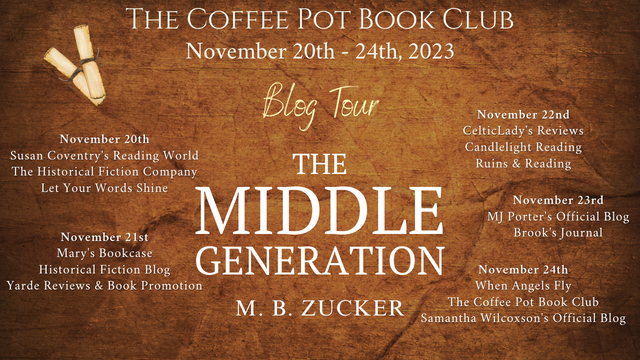
The Middle Generation


I'm doing something a little bit different for this stop on the Coffee Pot Book Club tour for The Middle Generation. Normally, I would welcome author M.B. Zucker to the blog, as when he visited before. However, this time, I couldn't resist the opportunity to read his newly released novel and share my review with my dear readers. So, welcome to my blog's first book review! 

As some of you know, I have great admiration for John Quincy Adams, the protagonist of The Middle Generation. I was captivated from the first page when I realized that Zucker had not only written about the great JQA, he had done so in first person from John Quincy's point of view!

How exciting!

And how intimidating! I have toyed with the idea of writing a novel about Dolley Madison, but I hesitate when I think about being tasked with writing dialog for the Great Little Madison. How could I sufficiently enter that amazing mind? So, I was enthralled to see how this author had done so with one of the most accomplished statesmen of the nineteenth century.

The book opens with Adams in a cabinet meeting where he is the smartest person in the room. He is always the smartest person in the room, and like most men who find themselves in this position, he knows it. I laughed to myself at his observations of Treasury Secretary Crawford (whose presidential candidacy I'm sad to admit James A Hamilton supported). It was a great start that sets the stage for the intellectual story interspersed with Adams snark that this novel promised to be.

We also see the more personal side of JQA, and how he holds his family to the same high standards to which he holds himself. This habit, inherited from his own parents, is damaging to relationships and many of the Adams clan that turn to alcoholism to escape it, but John Quincy, like his father before him, demands perfection.

When John Adams informs his son that he "must" achieve the presidency - and hold it for two terms, JQA feels the pressure even as an adult at that time serving as Secretary of State.

"It was now an issue of life and death. Failure would destroy me and my family. A disgrace for generations. Through history. My name synonymous with shame."

This just before Abigail rings in with her own dig at them both, "Yes! We shall have a two-term President in this family."

And you thought you came from a dysfunctional family!

This novel is introspective. It serves to give access to the reflections of John Quincy Adams to those who will never read his volumes of diaries. Having read some of the entries that have pertained to my own research, I believe Zucker has retained the character of JQA in the thoughts and dialog he has written for him. And there's lots of dialog. As is appropriate for a novel about JQA, more time is spent in conversation than in action, and those discussions take place with all of the biggest names of the day: Monroe, Calhoun, Clay, and a variety of foreign diplomats.

The reader gains an appreciation for the work of Secretaries of State that often gets little attention or respect. JQA worked tirelessly to gain the US status as a strong, independent nation, and he had a vision for his Presidency that would have benefitted Americans if they hadn't been so obsessed with the authoritarian brute they elected to replace him instead. Adams was, like many great men before him, too far ahead of his time.

This novel ends before he fully realizes that, with his inauguration and hopes still intact. Maybe Zucker will write more about JQA. I'd love to follow him through his presidency and the defense of the Amistad captives - those years where he fully recaptured any virtue he might have feared lost through his partnership with Clay.

I wish Americans were more interested in these formative years of the early 19th century. If you are, I recommend picking up this book.


The Middle Generation: A Novel of John Quincy Adams and the Monroe Doctrine
by M.B. Zucker

The classical era of American history began with the Revolution and ended with emancipation. Between these bookends lies the absorbing yet overshadowed epic of a new nation spearheading liberty’s cause in a world skeptical of freedom arriving at all, much less in slaver’s garb. M. B. Zucker takes readers back to that adolescent country in the care of an enigmatic guide, John Quincy Adams, heir to one president by blood and another, Washington, by ideology. Adams is the missing link between the founders and Abraham Lincoln, and is nigh unanimously regarded as America’s foremost Secretary of State. Through Adams’ eyes, readers will experience one of history’s greatest and most forgotten crises: his showdown with Europe over South American independence, the conflict which prefigured the Monroe Doctrine. 

With his signature dialogue and his close study of Adams’ 51 volume diary, M. B. Zucker’s The Middle Generation is a political thriller and character piece that surpasses his achievement in The Eisenhower Chronicles and ascends to the cinematic heights of the historical epics of David Lean and Steven Spielberg. It is an unforgettable portrait and a leap forward for one of our rising historical fiction novelists. 


Get your copy at Amazon, Kobo, or Barnes & Noble.
If you're in the DC area, check out your local B&N for copies!


Connect with M.B. Zucker


M. B. Zucker has been interested in storytelling for as long as he can remember. He discovered his love of history at fifteen and studied Dwight Eisenhower for over ten years. Mr. Zucker earned his B.A. at Occidental College and his J.D. at Case Western Reserve University School of Law. He lives in Virginia with his wife.

Connect with him through his website or on TwitterFacebook, InstagramLinkedInAmazon Author Page, and Goodreads


If you enjoyed this review, please join me on Goodreads! While I don't review 100 books each year as I once did, I do share what I'm reading & some reviews on those books that I feel most strongly about. I'd love to know what you're reading too!